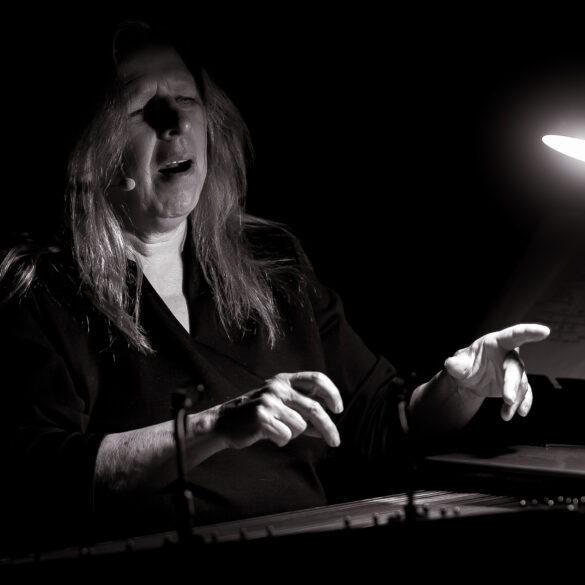
This was the only night I could conceivably visit Kanazawa, and fatefully, Sinikka was performing at the historic Mokkiriya jazz cafe and live house, founded in 1971, on this night, on tour from Norway. Meeting her in western Japan was as fortuitous as it is unlikely. Sinikka performs jazz-inflected songs inspired by the traditional music of the Forest Finns on a 39-string kantele (a kind of harp that sits horizontally on a table) that are haunting and unforgettable.
Sinikka’s singing is as clear as a bell. Yet, the purity of her voice and her decisive intonation, coupled with the dulcet sounds of her instrument, also express something profound, conveying compassion, mystery, and an ancient knowing. Gently, her music flows all around us, free of impurity and full of wonder, like a spring whose pristine and paliative waters well up from some primordial source. I wanted to know what makes Sinikka’s music so grounding, purifying, and ethereal — and what she was doing in Japan!
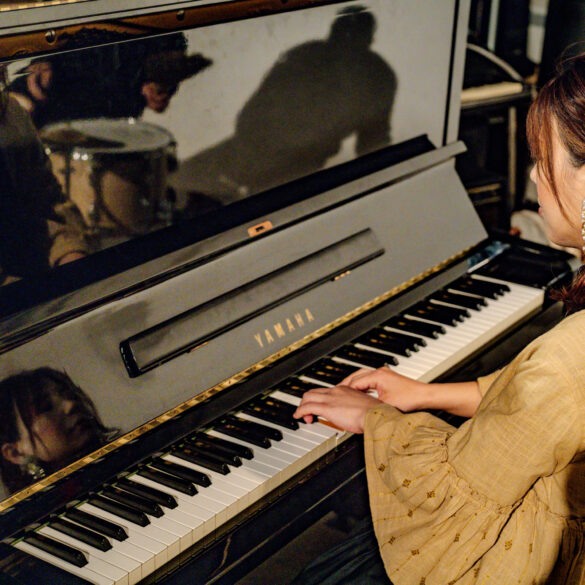
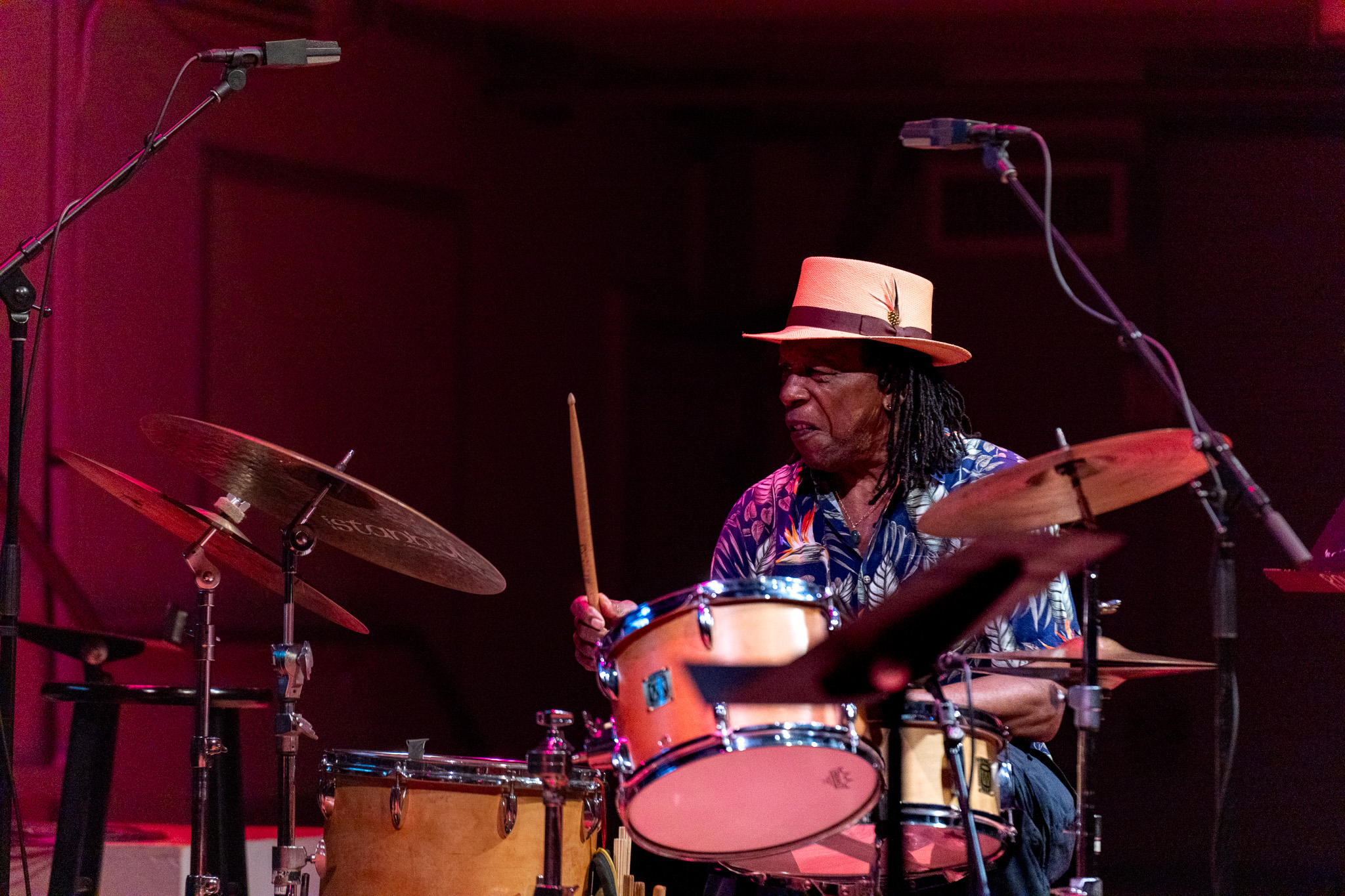
While struggling to find contemporary jazz venues in Osaka, I stumbled upon Studio T-Bone, a venue supporting both live jazz and photography and decided to visit. Pianist Yukari Sekiya 関谷 友加里 and percussionist Naoto Yamagishi 山㟁直人 やまぎしなおと were improvising together. While I didn't manage to get to know them well on that occasion, I was delighted to spend time with the creative family members running the studio. A chance encounter months later unexpectedly brought Yukari back into my mind. When I reached out to her, she responded, and I've now learned what a deep and inspiring artist and person she is, opening the door to possible future collaborations. It was a powerful reminder that we can't always see right away why our intuition speaks to us. Sometimes, it may be setting something in motion far in the future or for a purpose quite different from what we imagine.
I don’t know why I came here. Waking at four in the morning, inside this airtight dormitory room with no windows, I can only tell the time from the screen of my phone. Below my bed, the Afghan girl is snoring softly. I imagine her bed, surrounded by piles of stuff hung haphazardly like a rumpled bed curtain. She’s been here for two weeks; the items hanging around the bed are a way for her to assert her attachment, her sovereignty, and to establish herself more firmly than the others, which currently consist of me, a Cambodian girl, and an Indonesian girl.
The world is full of people who leave the place they were born, only to survive and then die in a place they never expected to live. The world is full of people who live without purpose, without any relationships, without any stories, or many that no one cares to know, despite the constant progress of everything around them. Such people tend to appear the most often in America, and even more in New York, the place where the no-identity-faces gather, the embodiment of the splendid America, the image that represents the most solid but also the most easily shattered dreams.
I saw one of them on the first morning after arriving in New York right after stepping out of a concrete hotel on Twenty-fourth Street, heading towards Seventh Avenue. For a moment, I had the idea of doing something different from the drivers — that is, following the African man to his destination.
Perhaps it was a kind of revelation when I realized what I longed for was a lake. A still lake, shrouded in mist — peaceful, yet faintly uncanny. And Morcote, by Lake Lugano, appeared as the answer, after just a few seconds of searching on my computer. Since then, Morcote has become synonymous with Stillness to me, a word I return to whenever I need calm within my own mind.
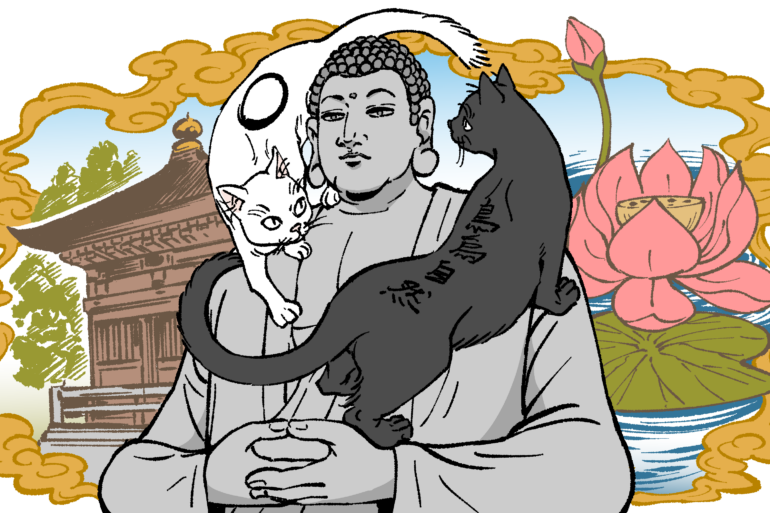
Photo © by Hiroki OtsukaOn my way from Kanazawa down to Hiroshima, I took a detour in Fukui Prefecture to visit Gotanjoji, a Sōtō Zen temple in Shoden-cho, Echizen City, known informally as a cat temple. I came for the cats, but I was also intrigued by the temple’s history, such as it is. While many temples in Japan are hundreds of years old, Gotanjoji was founded in 2002! Despite the temple's young age, its history dates back to the late 13th century Zen monk Keizan Jōkin 瑩山紹瑾, who was born in Echizen and was, I discovered, instrumental in opening Zen to women. Gotanjoji took it one step — or four? — further, bringing cats into the spiritual practice.
Ever since I was a child, I have always known that the world around me was much larger, that it was not limited to a small market, a moldering temple with a desolate courtyard, a solid church that I had not entered, rows of houses, schools, and a highway. That poor and ragged landscape never limited my imagination. I did not know how I got there, but I always knew that one day I would leave it. I knew I would travel to other vast places, reach the tops of mountains, dive to the bottom of the sea, and talk to people in every corner of the world.
The previous night, the snow fell heavily. The snowflakes fell gently yet fiercely, floating through the night like magical creatures. The cold crashed on me suddenly as soon as I stepped outside, aggressively occupying all the corners in my body, sneaking into every inch of carelessly exposed skin. The cold froze on the skin, piercing my brain, aching with every breath. On cold winter nights like this, the best thing to do is to stay in a cozy room, drink a cup of ginger tea, and talk about everything — except politics, of course. Politics in Russia these days is taboo. Russians avoided the subject like a terminal illness. “War in Ukraine? No, don’t worry, we are fine.” They changed the subject. Except Varf Labec.
by Hai Yen Ho| November 9, 2025 | Literature Among the countless fragments of memory vying to become the most...
No More Content