

by Hai Yen Ho| February 6, 2026 | Literature
“Konnichiwa,” said the woman behind the supermarket counter as I placed an armful of groceries before her.
“Konnichiwa,” I replied absently. Here, almost everyone seems to think I am Japanese. Nearly a week has passed, yet I’ve barely spoken a word, except for the occasional, necessary exchange. Even my name, “Yen,” sounds indistinguishable from the Japanese currency. That assumption has become so natural that I no longer feel the need to correct it. Here, in this moment, identity has lost its weight. I do not know what to do with it, nor do I feel compelled to reclaim or redefine it.
“Pip, pip, pip.” The register beeped dryly with each item scanned. Clad in a cream-colored apron now faded with time, her skin, too, seemed tinged with the same pale weariness. She stood motionless, like a plaster statue — face blank, hands brisk. She turned each item to find the barcode without ever glancing at what I’d chosen. Not that there was much to see: a few breadsticks, a wedge of brie, smoked salmon, a box of Caesar salad ready to eat once stirred, some biscuits, and a couple of bottles of mineral water, enough for a few flavorless meals to tide me over until the next errand.
I gathered my purchases into a paper bag and boarded a bus bound for a place named after paradise itself, Paradiso, where the quiet village of Morcote awaited me. The house I had rented for the week was painted a fading orange, set along the main road — the lake on one side, the mountain on the other — surrounded by a cluster of small, brightly colored homes stacked in terraced harmony along the hillside.
True stillness of the mind is not the kind that depends on one’s surroundings — and yet, the two are quietly intertwined. It takes a certain kind of space to drain the lingering noise from one’s thoughts. It took me some time to realize that my kind of space is one that bears the traces of time but is emptied of human presence. The faded orange house, with its small, silent rooms, was precisely that.
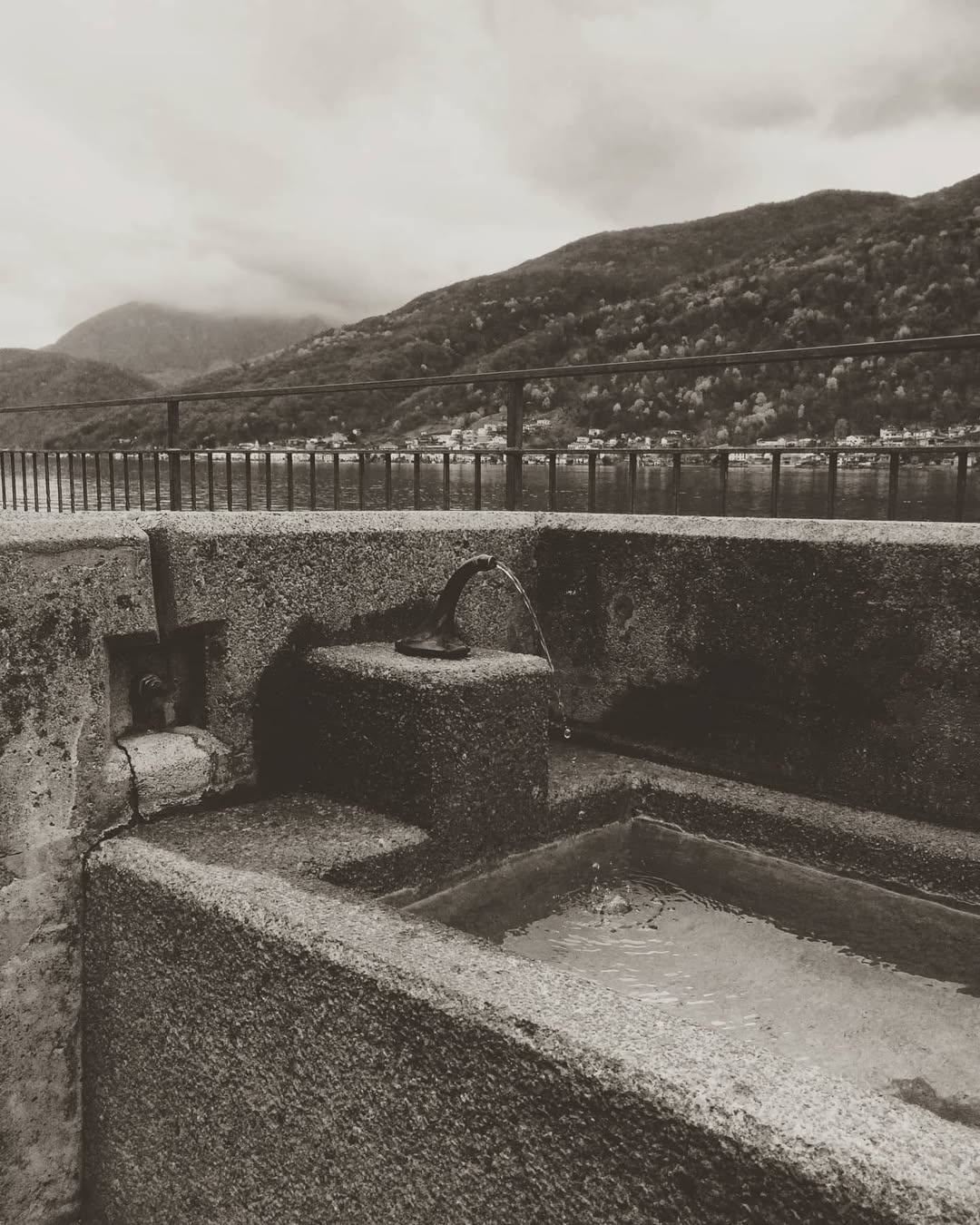
In contrast to the lush scenery outside — the tall pines and cypresses guarding ancient monasteries, the bursts of bougainvillea scattered across the village — my room evoked no particular charm. It was simply a place to sleep: one window, one bed, one desk, one wardrobe. A rectangular chamber with a low ceiling, its iron-grilled window curved gently toward Lake Lugano. I looked out at the vast expanse of water — immense, still, blue as glass, bordered by rows of willows and stone-paved embankments. It was March, and though the lake had not frozen over, its surface remained cold and dense, barely rippling. There was nothing superfluous, nothing decorative, nothing that sought attention. In the corner sat my suitcase, neatly closed — the only signs of my presence being a few books, a notebook, and a fountain pen resting on the desk.
It was, I suppose, a tidy place, but profoundly empty. Below the house was a small restaurant, and the only trace of human life came from the faint clatter of pots and pans entering the room. I never saw a soul – only the sounds of movement. I couldn’t even be sure if there were other guests staying that week, or if anyone else inhabited this part of Morcote at all. The woman who had greeted me outside, carried my luggage upstairs, and handed me the key had vanished thereafter. Now and then, a set of footsteps would stir the silence, ascending or descending the stairs, then stop, and the strangeness of stillness would flood the air once more. It reminded me of the apartment I had left behind.
During that time, anyone who stepped into my apartment would be struck by its distance, a kind of coldness that existed both in matter and in spirit. Everything was pared down to its barest form: a palette reduced to shades of gray and white, a few pieces of furniture just enough for daily use. Twice a week, I rode twelve kilometers to the office, stopped by the supermarket on my way home, filled my cart with food, and stocked the refrigerator. For a long stretch, that was how I lived — without emotion, without personality, without joy or sorrow. I came to realize that what terrifies people most is not sadness, but that dull, neutral state in between. It was then that I found myself swallowed by the endless flux of life, hollowed out after all that had happened. The air inside my apartment grew so dense and cold it felt almost tangible; and beyond sitting in it — working, thinking, waiting for the day to end — I no longer wished to step outside or confront the world. It was a kind of indefinite suspension, both within and without, that confined every urge to live, to feel, to seek.
In that vast emptiness of space and of mind, I floundered toward a solution. And perhaps it was a kind of revelation when I realized what I longed for was a lake. A still lake, shrouded in mist — peaceful, yet faintly uncanny. And Morcote, by Lake Lugano, appeared as the answer, after just a few seconds of searching on my computer.
Since then, Morcote has become synonymous with Stillness to me, a word I return to whenever I need calm within my own mind. I think of those days by the lake, wrapped in the unending chill, watching the sun sink slowly into a corner of the water until darkness enveloped everything. Even now, when I silence my phone, mute every notification, close the door, draw the curtains, and spend days without uttering a word, I can never quite find again the silence that existed by Lake Lugano that year.
In truth, I still do not understand how the human mind works — this endless looping of memory, this curious instinct to travel far in search of stillness that others seem to carry naturally within. Whenever I drift into confusion or quiet fury, I turn to Patrick Modiano, Milan Kundera, or Marguerite Duras — their words softening the restless impulses of youth. I always carry one or two of their books as a quiet reminder. Saigon. Hanoi. Frankfurt. Basel. And Morcote.
In Morcote, I reread The Lover, imagining myself as the girl in the man’s fedora, wearing scuffed shoes and faded lipstick, surrendering to a love with a Chinese man that defied every rule, while being caught in the tangle of family and desire. And in Morcote too, I revisited a few old stories, a few old names, until the wind carried them away, the anger, the tenderness, the regrets alike. It was the first time I truly understood the quiet power of traveling alone.
That was seven years ago.
—
In Morcote, I began each morning by staying wrapped in the warmth of my blanket. Mornings here arrived far later than they did in Vietnam — past six o’clock, yet the world outside still drowned in a pitch-black haze. From afar, a veil of mist hovered over Lake Lugano, thick and secretive, stirring in me a vague sense of unease. I burrowed deeper into the sheets until I could delay the act of waking no longer.
In the darkest years of my youth, I was terrified of mirrors, or more precisely, of facing myself, my memories, my story. Perhaps that was why I smoked and drank so much; both had the power to blur the face, whether by physical or spiritual means. Alcohol and nicotine seeped directly into the blood, dulled the senses, slowed the gaze, and drew me into sleep faster. A small reprieve from my own consciousness, from the burden of me. The stillness brought by alcohol or smoke is nothing like true stillness; it is a forced quiet, fleeting and false, leaving behind no peace when it fades. I knew that, yet at the time, it felt inevitable — something that had to happen, if only so I could keep moving forward.
When I finally rose from bed, the first thing I did was slip into a thick wool coat, pull on my boots, and wander around the lake. In that spring chill, the town felt almost deserted; during the week, I rarely saw another soul. Only on weekends did life reappear, with elderly couples in impeccable coats strolling beneath the cypress trees, young people gliding their kayaks across the mirrored water, and children — the fewest in number, yet the loudest of all — shrieking and running wild as their mothers kept patient watch, rising in sudden bursts of worry. That quiet vigilance, that unspoken devotion, seemed to me one of the purest expressions of love. And in that moment, when the thought came, it was family — not love affairs, fleeting or profound, joyous or bruising — that rose to the surface of my mind.
I never made it around all of Lake Lugano; it was simply too vast. I would walk until I found a spot that felt right, take out my notebook and laptop, work a little, write a little, then return to my room to eat, only to head out again at dusk, circling back as the sun sank into the water. I repeated that rhythm for an entire week, from the first morning to the last, and nothing changed. Yet truthfully, I accomplished nothing of substance, neither in work nor in writing. I spoke to no one, made no new friends, tasted no local dish. My only small triumph was abstaining from both alcohol and cigarettes, things I had indulged in too much before arriving.
Here, by Lake Lugano, a new order quietly took root within me, dismantling every old habit I’d had. I could not say what was happening to me, but I knew; something within was shifting. Each cell seemed to die and renew itself at once. My mind, my habits, my temperament, all were changing, subtly, steadily. It was as though I were on a pilgrimage, holding my silence, yet letting that silence speak for everything that had happened to me — wildly, noisily. And then, utterly still.
—
I still remember that final afternoon in Morcote — sitting cross-legged on the bed of pale pink pebbles, watching the sun sink over the lake. I had never seen pink stones before, not then and not since, which is perhaps why that memory feels so close to a dream. The sun scattered its golden dust across everything — the pine boughs, the stone embankment, the trembling water, and over me as well. Facing the blinding light, I replayed my past in my head, over and over again. The things I had lived through seemed small now, yet they remained deeply, painfully real, with too many facets to count. Perhaps that is why they kept finding their way back into me, spreading, radiating outward, until they stood before me like a glowing monument in the dark — a monument to the person I once was, to the years that could never return.
As I looked at everything from that new vantage, I realized how damaged I had truly been — not just scratched, as I once thought. My instinct for survival had pushed me to ignore both cause and consequence, to simply keep moving. But it was never only about separation, regret, or sorrow. It was something larger, a failure that follows my relentless effort, a wound to my own pride. In the end, I had not succeeded as I had wished. I used to believe that once a heartbreak had passed, the pain would fade. Instead, new wounds arrived, each one taking its turn to quietly erode me from within, mercilessly.
That pain, if it could take shape, would look exactly like the dead fish lying before me.
It was black. I could not tell what kind, but it was clear it had spent its life in the waters of Lake Lugano. Strange, I thought, how I had walked the lake’s edge for days without seeing a single fish, until this one appeared — ravaged, covered in hundreds of tiny wounds. The culprits were the dark brown crabs crawling nearby. Beneath the glassy surface, under the fish’s torn flesh, the crabs kept inching forward, picking away at what little remained, leaving behind wisps of tissue fluttering weakly in the water. There was no blood — the bleeding must have stopped days ago, then the fish finally died. What was left was a twisted form, incomplete, impossible to imagine as something once alive.
But I was wrong.
From nowhere came a faint splash, and when I looked down, right by the toe of my shoe, the fish I thought dead was still fighting, struggling to turn itself over once more. Its eyes flared open, suddenly alive, replacing the frozen dullness of moments before. A few threads of flesh still trembled, and I could almost feel the unbearable pain that ran through its body. I wondered, in that instant, what all that desperate effort to live was truly for.
“Are you having a good time, dear? When are you coming home?”
My phone lit up with a new message. It was from my mother — her first after several silent days.
I had never been one for family talk; I rarely told anyone at home about my private life. For reasons I can no longer name, or perhaps simply through time’s quiet work, my family had learned to accept that silence as part of me. They all knew I was struggling with something, though no one knew quite what. And those two short sentences were her way of reaching across the silence, of reminding me that, unlike the wounded fish, I didn’t have to fight alone. They would never let me.
“I’m fine. It’s beautiful here. I’ll check out tomorrow and head straight to the airport.”
Typing that reply reminded me how few hours remained before I would wake and leave for my flight back to Vietnam. It also reminded me of Duras — how, for all her self-entanglement in endless love affairs, she could never unbind herself from family: from her dead father, her furious mother, her cruel, addicted brother, and the other, frail one, fearful and adrift. Of the fact that sometimes we must walk away from the lives we were never meant to have, to choose something else, no matter how much it hurts.
I dipped my hand into the water — the cold cut deep once again remind that I was still here, in Morcote, by the lake, and that this journey had fulfilled its purpose. A week of wandering around the icy shore had brought me a semblance of peace. Not to ease the pain, but to relive it, freeze it, and then let it melt away, day by day. Whatever happens, I have always known that time would bring me back to myself.
There was nothing to look forward to — not in those pale spring days of distant Morcote. No youthful thrill, no tender hope. Only sunlight that gleamed but carried a chill so bitter it could freeze anyone who dared step into that realm of aftershocks, of memories, of pain.
And suddenly, I found myself weeping, weeping like rain, before that dying fish, still struggling for its final breath.