


by Christopher Pelham | March 4, 2026 | Theater
Recently, I’ve noticed a surge in theater productions in NYC created and performed by Asian artists — each wildly different and inspiring: the South Korean musical Maybe Happy Ending on Broadway, Zoe Kim’s Did You Eat? (밥 먹었니?) at the Public Theater, Soomi Kim’s Chang(e) at The Tank, Aya Ogawa’s Meat Suit at Second Stage Theater, and Vivienne Chen’s Future Came and Went — Epilogue after Three Sisters at Wild Project, among others. The latter, co-produced by Sparkling Theater Company, a young and energetic Asian troupe, first brought the work of Sparkling’s artistic director, Tara P. Nyingjè 寜婕, to my attention and led me to her production Qing Bai: Innocence at HERE Arts Center.
What’s made this surge possible isn’t visibility alone but infrastructure: Asian-led companies producing Asian artists and informal networks of collaborators who share resources, learn production skills on the fly, and passionately show up for one another’s work. These productions are not token gestures; they showcase talented artists telling fresh, meaningful stories to full audiences eager to see the richness of their diverse experiences reflected on stage. Larger institutions are beginning to take notice and present this work as well — but today I want to celebrate the labor, both on and offstage, that Asian artists themselves are doing to make it happen, focusing on Tara.
Tara is very much part of this new generation of theater makers who create, perform, and produce their own work. Her production Qing Bai: Innocence was inventive, visually striking, and performed entirely in Mandarin. I had the good fortune to meet her after the show, and her effervescent creative energy was immediately apparent. Only two years out of NYU, Tara already has an impressive list of credits. She grew up doing theater in Shanghai, where her parents recognized and encouraged her early passion for the stage.
“My mom thinks everyone has something they need to finish in their life… everyone has a talent you just have to go with… My dad even started to write some scripts for me.” From a young age, Tara had learned to follow her own instincts. When I asked whether she hesitated to stage a play in Mandarin in New York — or met any resistance — she said she hadn’t even thought about it. She wanted to do it, so she did it. And her instincts were justified: her production sold out.
As someone who was always unabashedly “expressive and weird” without worrying what others might think, she says she really fit into the New York City vibe. She came to NYU and fell in love with the Experimental Theater Wing. “ETW gathers all of the weirdest people in the world. I felt very connected and accepted there.”
While ETW exposes its students to many kinds of theatrical training, Tara felt most at home with the traditions of Michael Chekhov, Grotowski, and Viewpoints, methods that focus on the body as the site of storytelling. “They focus more on storytelling and theater-making, on how to create your own story and tell it in the way you want. I feel like there’s a gap between me and the world. But then, when I get into my body, I know what is happening through my physicality.” Even when she’s working from a script, she treats it as scaffolding — something the ensemble can test, physicalize, and reshape until the production finds its own visual language.
For me, that physical, visual approach proved essential in Qing Bai: Innocence becauseit was the first play I’d seen performed entirely in Mandarin, which I don’t understand. Tara’s staging and the performers’ physical expressiveness communicated the story so clearly that I didn’t need to rely entirely on the English supertitles. And there was a lot to communicate. While the story itself is simple, the production’s themes and choices are sophisticated, provocative, and unmistakably modern.
The play is an adaptation of one of the most widely adapted and well-known Chinese stories, The Legend of the White Snake (白蛇传 / Baishe Zhuan), which dates back to the Tang dynasty (7th–10th centuries) and appears in the famous 17th-century collection Stories to Caution the World (警世通言, Jingshi tongyan) compiled by writer Feng Menglong. In the story, the white snake spirit Bai Suzhen transforms into a woman. Caught in a sudden rainstorm while walking with her sister, Xiao Qing, she’s offered an umbrella by a mortal man, Xu Xian. The two fall in love and live together — until the monk Fa Hai grows suspicious, exposes Bai Suzhen’s true nature, and accuses her of violating spiritual law. Because unions between mortals and spirits violate Buddhist law, she is found guilty and imprisoned beneath Leifeng Pagoda.
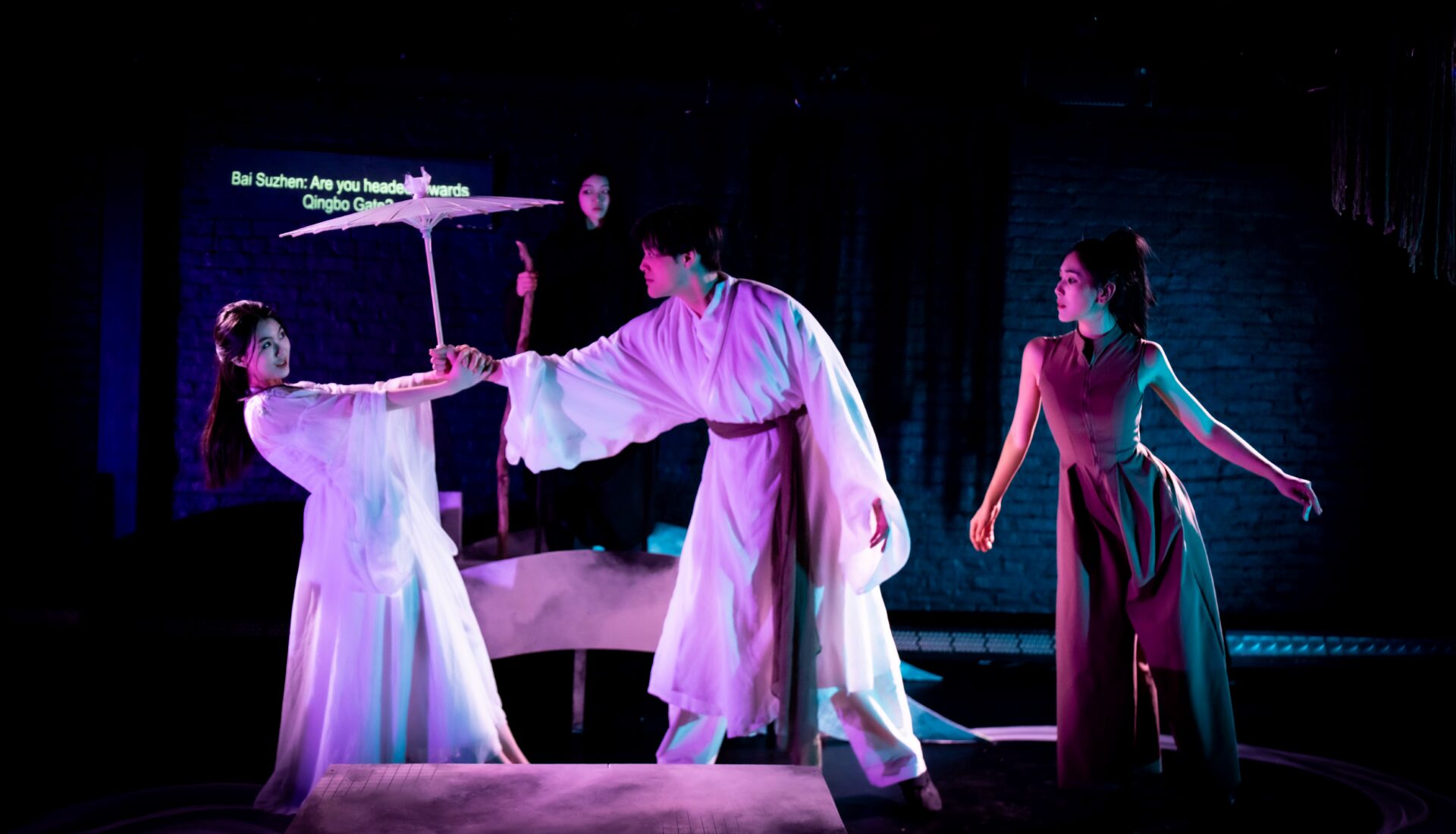
Tara had long wanted to adapt one of these old Chinese stories for the stage, and her family friend Ophelia He 何楚宁, now a student at Yale, suggested they adapt this story together. Ophelia translated it from Classical Chinese into Modern Mandarin. From this version, Tara then developed the theatrical script. Together, they convinced Yale to provide a theater for it, and Brown University offered them a residency to develop and stage it there as well. So the NYC production I saw is, in fact, their third iteration.
For Tara, the story’s appeal was not only cultural but psychological. “At its core,” she told me, “the story contains very universal emotions — loving someone you cannot be with, being separated by forces beyond your control, navigating rules that divide worlds: human, spirit, demon.”
And while Ophelia was the one who chose the story, once Tara began working on it, she realized that “it resonated strongly with my own life at that time. The story explores attachment styles — avoidant types, different kinds of lovers — and we did a lot of psychological research during the process. In a way, I was also working through my own personal questions while creating it. That made the process especially meaningful.” Turning that curiosity inward is central to both her process and her effectiveness as an artist.
Tara deeply meditated on the choice Bai Suzhen faces: between obeying authority and staying true to her heart. “And the hesitation people feel when they’re afraid to act. Those emotions feel deeply human to me.” She sees hesitation, rumination, vacillation, and repetition — of thoughts, behaviors, and scenes — as being central to the human experience, and much of her work seems preoccupied with it. Clearly, she believes that Qing Bai’s themes transcend their Chinese context and can be understood by audiences everywhere.
After all, even audience members unfamiliar with The Legend of the White Snake will likely recognize echoes of its tale — a temporary union between mortal and divine — in many other world folk traditions. For example, Greek mythology offers the story of Eros and Psyche; Japan gives us The Crane Wife and Snake Wife; Norse legend tells of the Valkyrie Bride. In fact, these stories are so common that anthropologists have created a category for them: “marriage taboo” or “fairy bride” narratives. They often explore anxieties about crossing social or cosmic boundaries, the fragility of love within rigid moral orders, and the patriarchal fears surrounding female autonomy and the perceived “unknowability” of the feminine. At heart, these stories pose a simple question: can love transcend the boundaries that societies try to impose?
What makes The Legend of the White Snake distinctive and particularly interesting is the trial of Bai Suzhen, which allows the storyteller to play with the story’s thematic focus without changing the plot. Throughout its long history, versions of the story would emphasize different themes simply by varying how the characters expressed themselves within the mostly fixed plot. Usually, these variations reflected the conditions and values of the time.
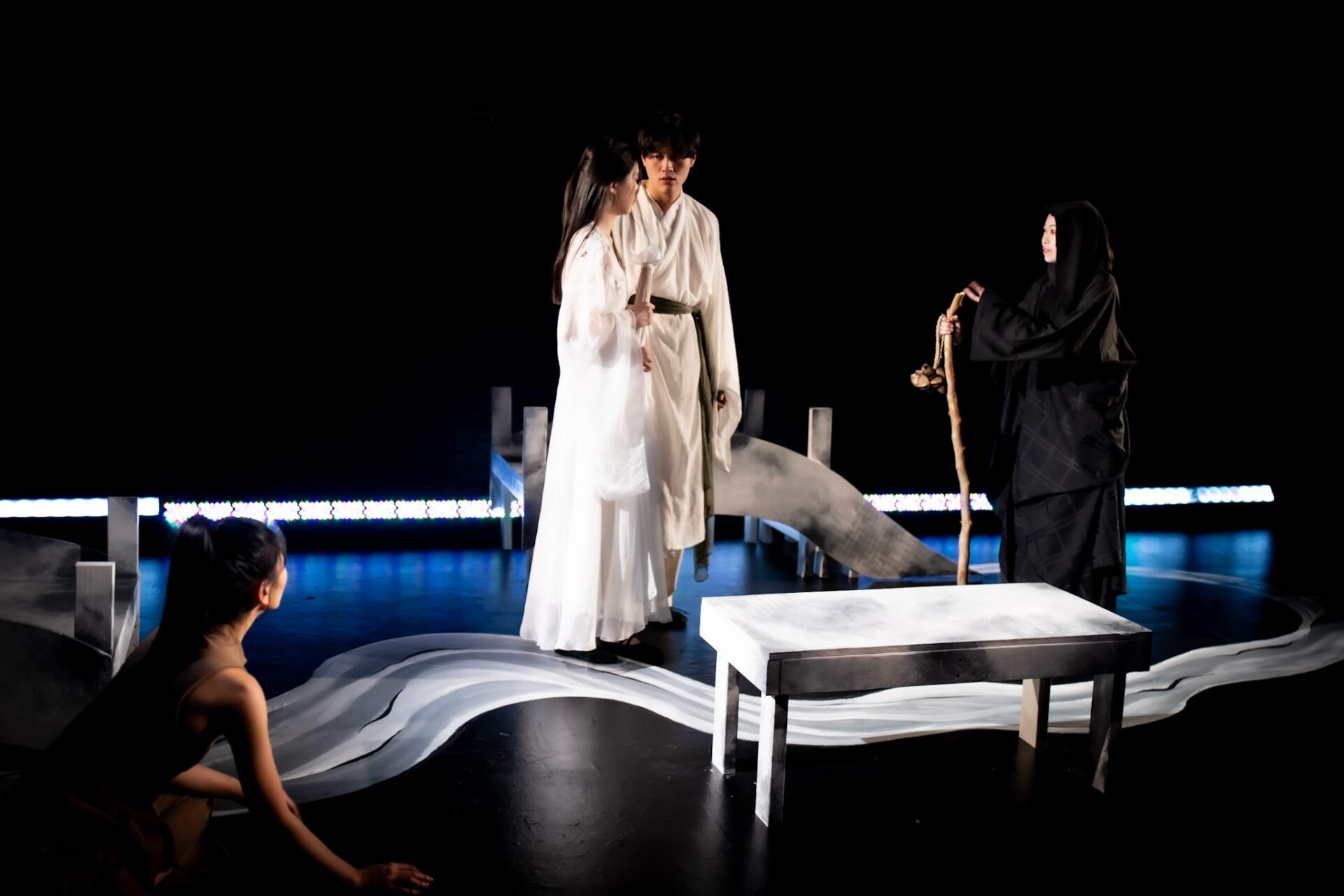
The earliest versions present the legend as a cautionary tale warning the audience to uphold the Confucian-Buddhist order and resist illusory and seductive temptations. When opera flourished during the Qing Dynasty, regional opera and Peking Opera adaptations such as Leifeng Pagoda portrayed Bai Suzhen as a sincere and devoted lover punished by rigid, uncaring institutional authority. Early 20th-century versions transformed Bai Suzhen into a feminist paragon of female agency and free love. Her judge, Fa Hai, is depicted as a dinosaur of cruel feudal morality, while her lover, Xu Xian, represents the weakness of patriarchy. During the Communist era, the emphasis shifted once again to illustrate the superiority of humanism over Buddhism and superstition.
Rather than adopting one of these interpretations in her production, Tara introduces an unexpected yet sparkling theatrical device that allows them all to coexist: she stages the meeting between Bai Suzhen and Xu Xian three times. In the first meeting, the encounter feels natural, gentle, and romantic. When the scene is repeated, Xiao Qing intervenes, warning her sister not to involve herself with the man. The production notes describe the umbrella as “a contested threshold of danger and desire.” Bai Suzhen appears to be acting impulsively and rashly, perhaps selfishly, according to her nature. But in the third and final version, one senses that Bai Suzhen accepts the umbrella calmly and knowingly. Accepting the umbrella becomes an act of consent rather than a matter of destiny. She knows the rules, but she nevertheless chooses to love.
The triple staging invites us to consider the multiplicity of possible interpretations. Is Bai Suzhen a heroine, a seductress, or a victim? Did Bai Suzhen seduce and entrap Xu Xian, or did she sincerely fall in love with him? Is the judge fair or cruel, a guardian of morality or an instrument of tyranny? Tara’s production poses questions rather than offering answers. It allows us to make up our own minds.
I responded most strongly to seeing Bai Suzhen as unapologetically feminist — a woman asserting, simply, “He’s my husband. I love him. Everyone has the right to love.” Other audience members likely viewed her differently. The play acts as a mirror, reminding us that our interpretations are subjective and that we impose our own judgments on the characters, just as Fa Hai imposes his judgment on Bai Suzhen in the story.
Tara made another strong visual choice by bringing in a dance company to embody Bai Suzhen’s snake form, which helped the audience to feel the dichotomy between Bai Suzhen’s existence as a woman and as a snake. Tara told me that she wanted the audience “to feel the vibe of the snake. It’s a dream she’s entering into when she is being judged, being questioned. And then it’s kind of a protective side of her to get into the snake form. We wanted to get into this rawness and this animal side of her.” She stressed that Bai Suzhen’s snake form is not monstrous but animalistic, natural, and protective.
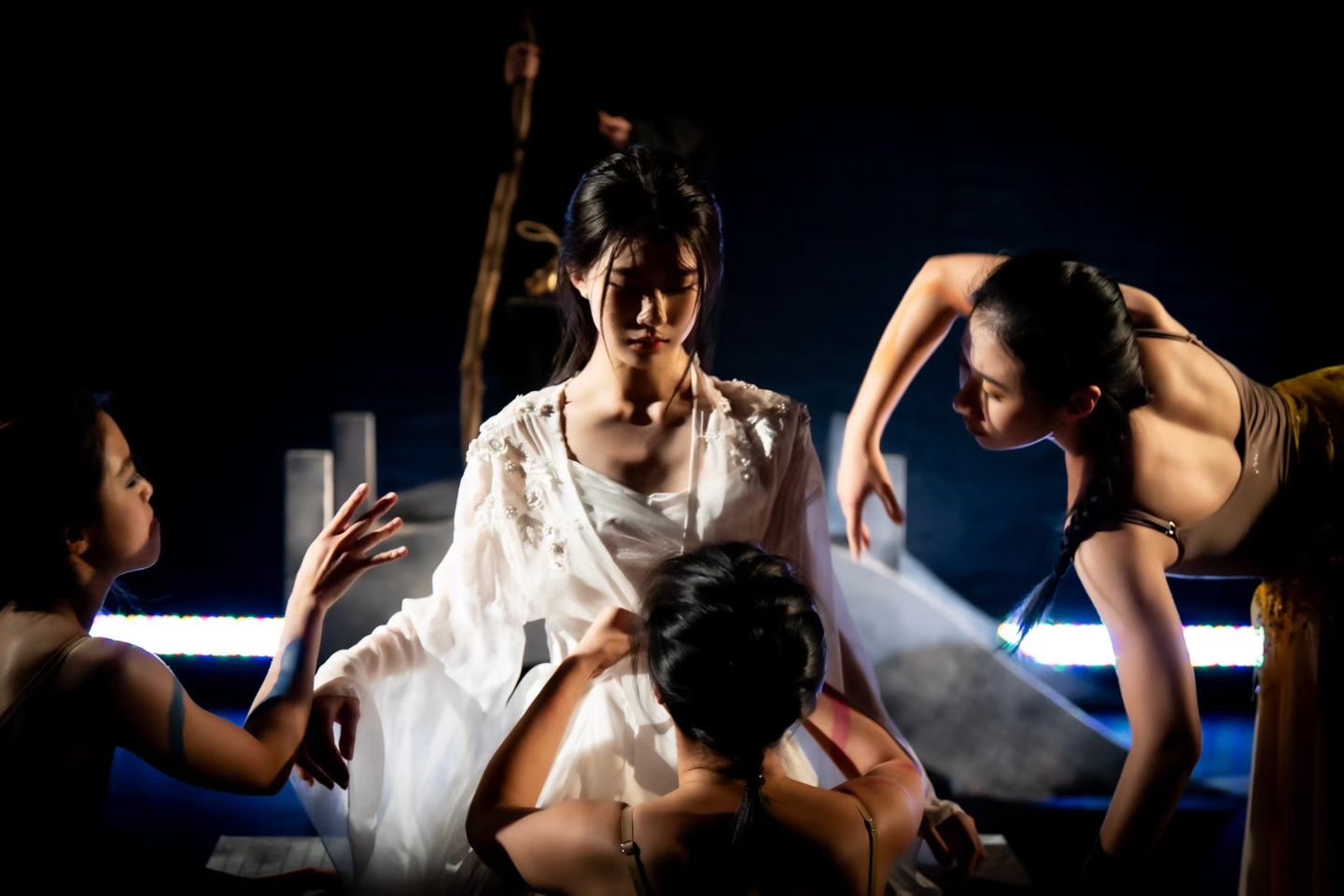
But it also proved challenging. Tara’s colleague Yannis Ning, who assisted with the integration of the dancers into the production, realized in rehearsals that the snake dance looked too “delicate, like choreography…. So we asked them to make this movement more instinctive,” more animalistic than dance-like.
Tara elaborated that “if we had had more rehearsal time for the dancers to get to know the story, what is happening, to get into some of the acting side, and then also to have the actors learn some of the dancing, and then to combine them in better ways, it would have been better.”
This points to one of the challenges of making theatrical work in New York City, particularly in the Off-Off-Broadway world. Production costs are high and rehearsal periods are accordingly short. Tara told me that while she strongly prefers to take time to develop the acting ensemble before plunging into staging the material, she had to produce the New York production of Qing Bai: Innocence on a short timeline.
“When I was looking for a venue in New York City, it was very, very late for this project. There is a very long artistic review for the HERE Arts Center to host any project, but maybe something dropped out. There just happened to be an empty space at the perfect time for me. And I think for me, I actually pushed it a little bit. I emailed them multiple times, and then I just came in person to push this forward.”
Tara has no formal production training. She has been learning through experience, and though she would rather focus on creating, she does whatever is needed to bring these projects to completion. Yannis said that she always maintains a positive attitude even when she must take on additional responsibilities. “That’s how they keep moving forward instead of getting stuck at any point.” For example, in the NY production of Qing Bai: Innocence, one actor had to drop out, and Tara simply took her place and kept going. Because Tara meets each obstacle with curiosity rather than fear, she treats them as creative prompts and finds ways to resolve them.
Tara is fortunate to be part of a network of Asian theater-makers and companies that has arisen in the past few years, a network she and Yannis have helped create. When Tara started at ETW, there was only one other Chinese student, Annora (Jiyun) Dong. Because they wanted to tell stories about Chinese culture, they began creating plays together and then founded the Sparkling Theater Company. Now, in addition to running Sparkling, Tara also serves as Managing Director of Dreamborne Theater and Stage Director of Asian Artist and Activities Hub (AAAAH!), a nonprofit research organization dedicated to advancing the visibility, understanding, and documentation of Asian artists and designers through design-led cultural research in the United States.
As Sparkling’s circle of collaborators expanded, the company began supporting projects by other emerging Asian theater artists as well. One of those collaborators is Vivienne Chen, whose play The Future Came and Went — Epilogue after Three Sisters Sparkling helped bring to the stage. Chen was a classmate of Tara’s at NYU and performed in Sparkling’s first production. After appearing in a production of Chekhov’s The Three Sisters, she wrote a sequel to the play, and Sparkling decided to help produce it.
Although Vivienne’s play does not fully align with Sparkling Theater Company’s mission to present physical, ensemble-driven theater, Tara chose to support it because she was struck by how convincingly Vivienne had captured Chekhov’s voice. But her achievement lies not only in the language. The story itself is impressive. The three sisters leave their provincial home after their parents’ deaths and finally travel to Moscow — the city they had long imagined as a place of culture and opportunity. Instead, they discover that the life they dreamed of remains just out of reach. Their aspirations collapse before they ever have the chance to take shape.
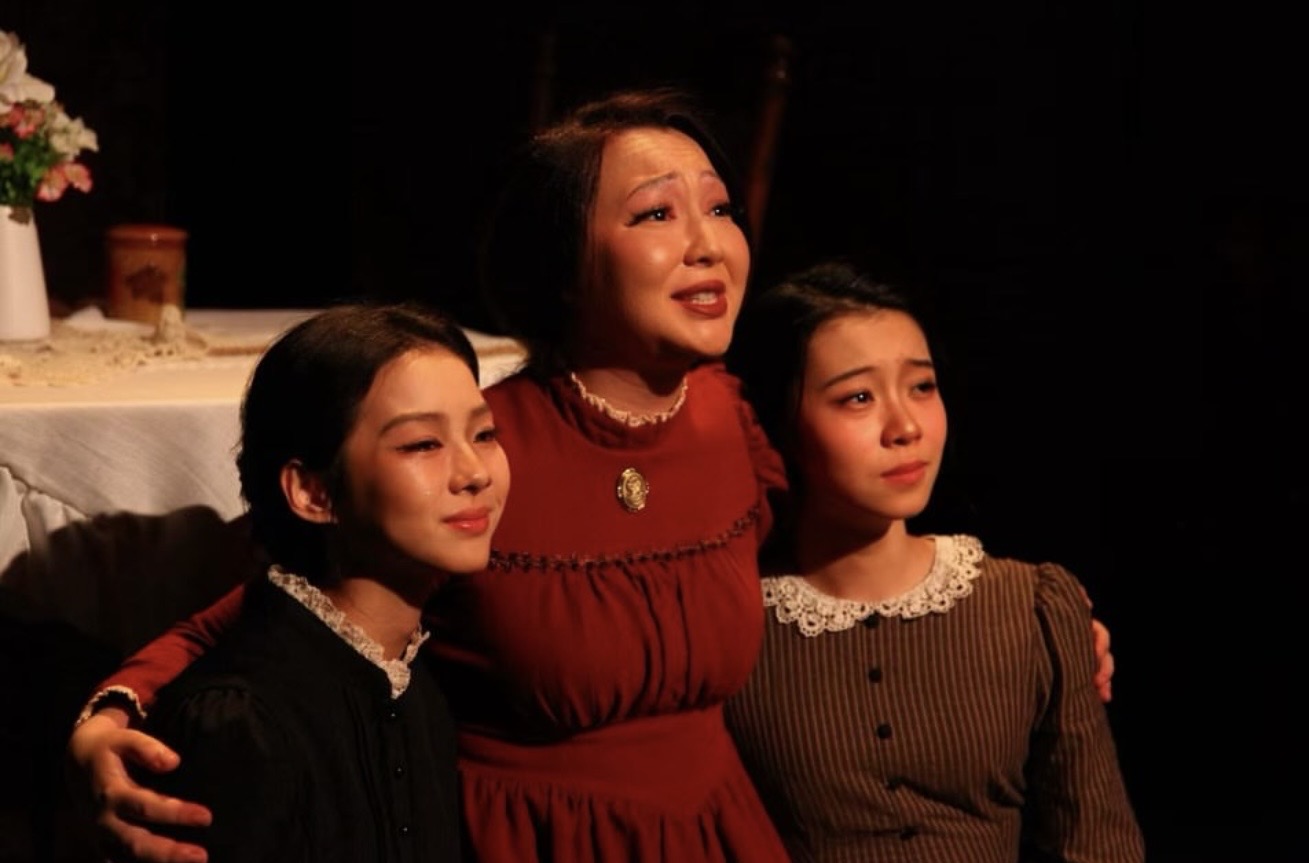
The play shows remarkable empathy for people caught in forces larger than themselves — political, patriarchal, and historical forces. It’s quite an accomplishment for an undergraduate student who grew up in a world far different from Chekhov’s. Supporting projects like Vivienne’s is part of how Tara and her collaborators are building the artistic ecosystem they themselves once needed.
When I asked why Vivienne thought to write such a play in the first place, Tara shared an unexpected insight: “In plays from that period, it always seems like the events don’t actually happen on the stage. The characters just talk about everything that happened. It’s like the experience today, living in New York City. Sometimes when you dream of the city, you think everything would be different when you get there. And then when you are actually in that situation, you might find something new, or everything just stays the same. More like it is repetitive. You’re still looking for something else. I think that’s a major point that you have to tell right now, right here, when we were both living in New York City.” This reminded me of something Tara had said earlier: she is drawn to works that help her better understand herself.
Tara and Yannis, who is pursuing a graduate degree in educational and therapeutic theater practices, have also built up a working relationship and theatrical community. Although their first production collapsed, they continued collaborating. When Yannis founded the nonprofit performance collective Dreamborne Theater, Tara became its managing director. Dreamborne’s mission is to develop and present cross-cultural and multilingual performances rooted in dreams, myth, and memory. Dreamborne is now producing Tara’s newest play, angels, which will premiere March 20–22, 2026, at TheaterLab NYC.
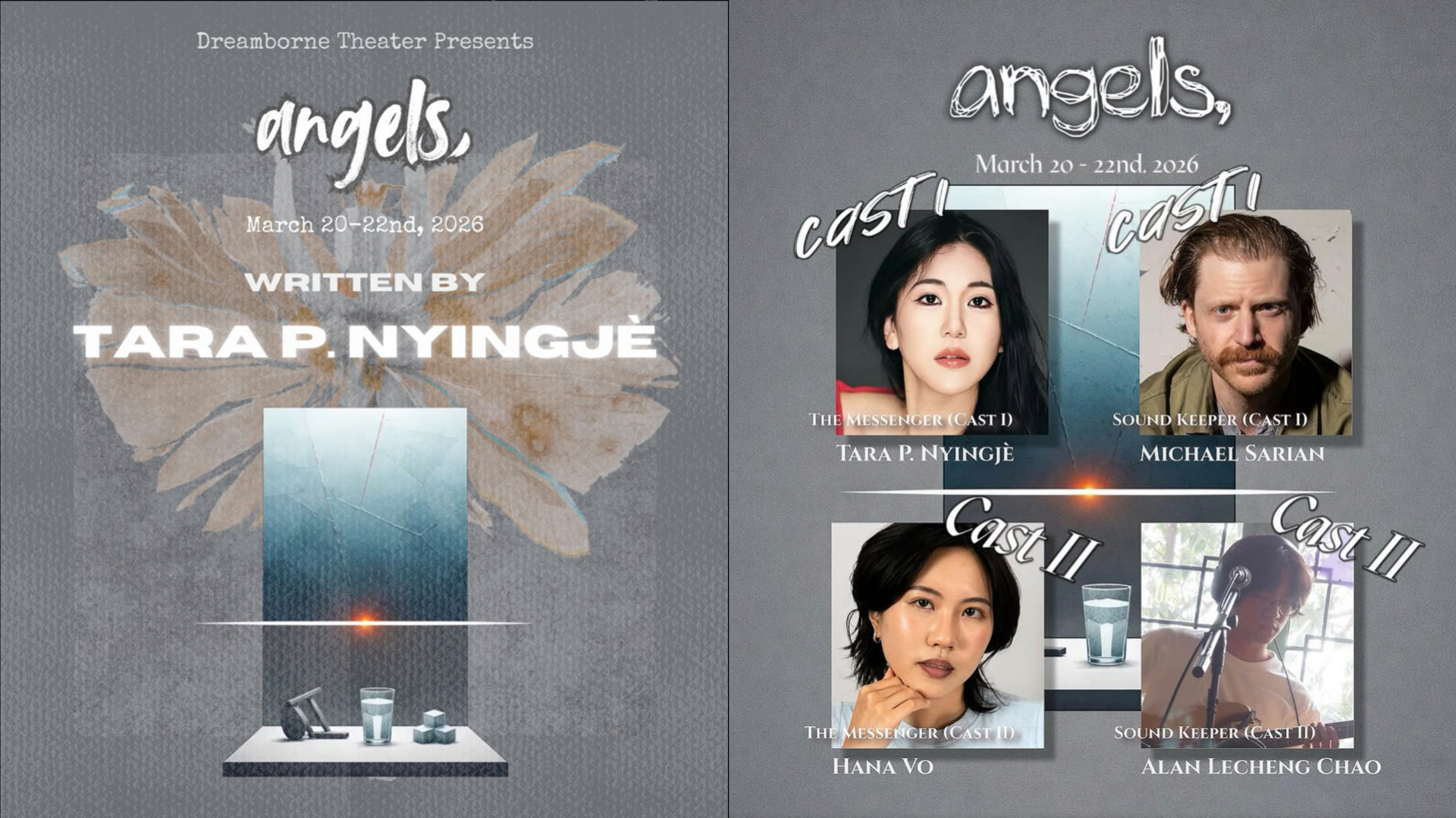
Although set in the present and performed in English, angels builds on ideas Tara explored in Qing Bai. Inspired in part by Waiting for Godot, the play begins with a simple premise: a woman walks into a bar, partly in hopes of meeting a man she once encountered there and partly out of curiosity about the strange ecosystem of bar life — watching and being watched, forgetting and remembering, thinking and acting. She talks to herself and interacts with the house jazz musician, who responds only through his instrument.
Rather than tell a linear story, the piece unfolds as a sequence of seven “loops,” each re-staging the same existential situation under shifting conditions of observation, desire, and consequence. The play will be performed by two alternating casts, underscoring Tara’s suggestion that although we may act differently in similar circumstances, we are often caught in the same patterns of thought, circling toward comparable insights. As in her earlier projects, the work grows out of Tara’s curiosity about her own inner life. At the same time, it invites the audience to reflect on the repetitive patterns shaping our own decisions and desires.
Given Tara’s appetite for experimentation and effervescent personality, the name of her company — Sparkling Theater Company — might seem inevitable. I assumed it reflected her vivacious energy. It turns out the origin is more literal.
“It’s sparkling, but it can’t just sit there,” she told me. “You can’t drink a glass of sparkling water the next day — it loses its bubbles. You have to drink it right now.”
In other words, it’s ephemeral — like live theater.
Like the other Asian playwrights I mentioned earlier, Tara is finding fresh ways to dialogue with tradition. What feels new in this moment is not only the work itself, but the entrepreneurial initiatives behind it: young artists building their own ensembles, companies, donor bases, and presenting platforms rather than waiting to be invited in. Artists from afar — and artists shaped by minority experience — often make visible what the dominant culture overlooks or ignores. Works like Tara Nyingjè’s infuse our culture with new energy and sharpen how we see both the world and ourselves.
You can learn more about Tara and her work at taranyingje.com and follow her on Instagram at taranje_
You can follow Sparkling Theater Company at @sparkling_ny and Dreamborne Theater Company at @dreamborne_theater.
You can follow Vivienne Chen at @vv_chenn and Yannis Ning at @nyeong_yannis.
Leave a Reply