Sylvester "Sly Stone" Stewart died on June 9th, 2025. There have been a lot of narratives about his life and death, but less about his music, particularly his under-appreciated 1973 album, Fresh. True to its title, Fresh is lighter, more relaxed, and much more personal than any music Sly had written to date. It's also much funkier, as Sly had in turn embraced the deep grooves of the Bootsy Collins-era JBs of James Brown.
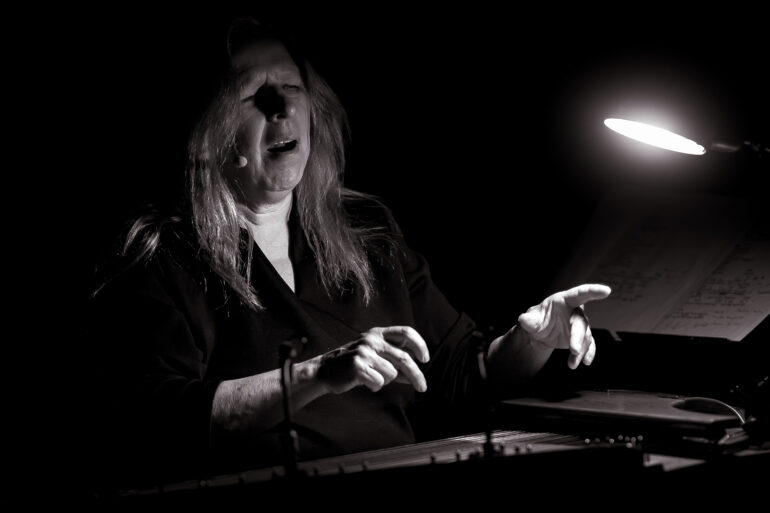
This was the only night I could conceivably visit Kanazawa, and fatefully, Sinikka was performing at the historic Mokkiriya jazz cafe and live house, founded in 1971, on this night, on tour from Norway. Meeting her in western Japan was as fortuitous as it is unlikely. Sinikka performs jazz-inflected songs inspired by the traditional music of the Forest Finns on a 39-string kantele (a kind of harp that sits horizontally on a table) that are haunting and unforgettable.
Sinikka’s singing is as clear as a bell. Yet, the purity of her voice and her decisive intonation, coupled with the dulcet sounds of her instrument, also express something profound, conveying compassion, mystery, and an ancient knowing. Gently, her music flows all around us, free of impurity and full of wonder, like a spring whose pristine and paliative waters well up from some primordial source. I wanted to know what makes Sinikka’s music so grounding, purifying, and ethereal — and what she was doing in Japan!

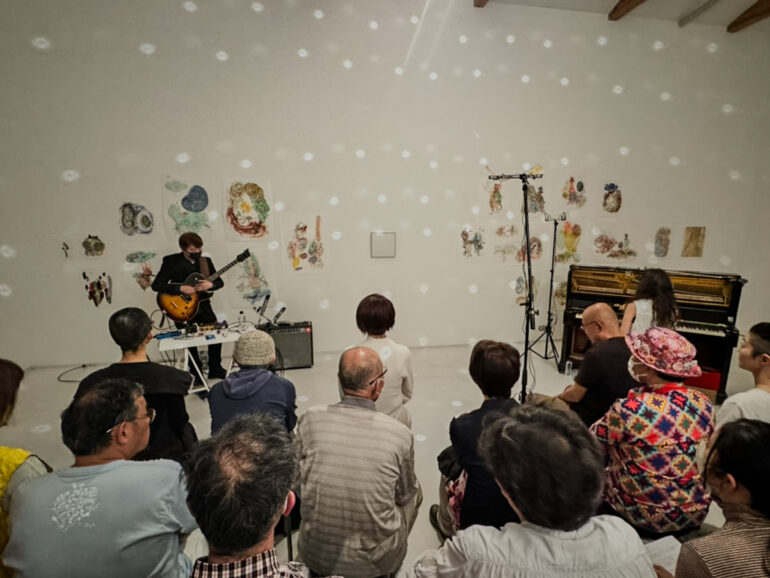
On my last night in Osaka, I attended the closing night reception for the solo exhibition 置き去られた鏡 The Forsaken Mirror by celebrated artist Chie Matsui 松井智惠. The performance consisted of music by avant-garde musicians sara (piano, perc.) & Shin’ichi Isohata 磯端伸 (guitar) and a poem read in Japanese, Korean, and English by Chie, Yangjah, and Miho, respectively. At first, I didn’t know what to make of the performance or the abstract, brightly colored prints surrounding a centrally hung mirror. Eventually, in the space created by the disorientation and abstraction, I reflected on who these people were, who I was, and the various identities we experience throughout life, which proved enlivening.
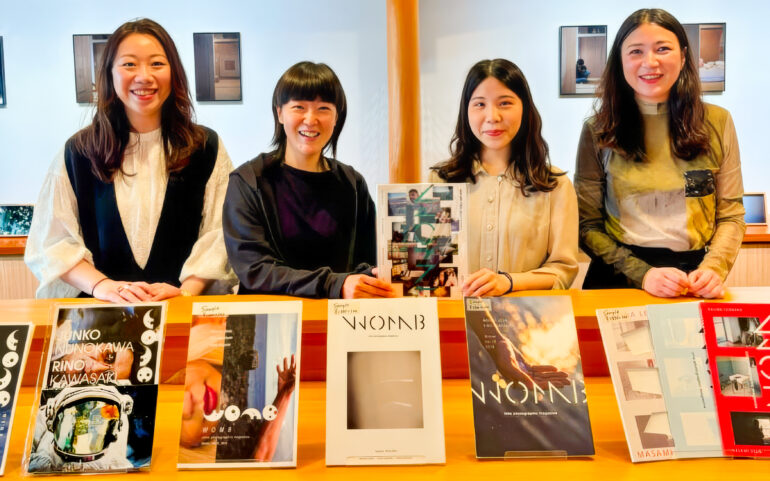
I had circled the KYOTOGRAPHIE KG+ Photographer Group WOMB’s 10th Anniversary exhibition as one not to miss. I was attracted to WOMB’s mission, which seemed to offer a feminine gaze yet take a metaphorical and expansive rather than body-centered view of a womb’s function. A small collective of Japanese female photographers who have been publishing WOMB photography magazine since September 2013, WOMB says they named their group and magazine to evoke “things that no one knows yet, a place where things are born (and grow).” Fortunately, I was able to meet two of the photographers, and among my many experiences at KYOTOGRAPHIE, this exhibition proved to be a highlight. Honestly, it was inspiring and rewarding beyond all expectations.
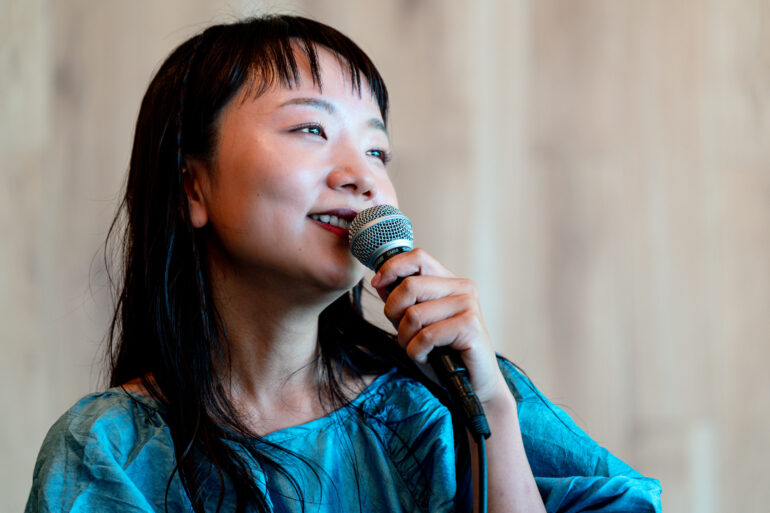
On a sunny 5th of May — Children’s Day in Japan — I made my way to what seemed like an unlikely venue, Mifa Football Cafe, for a matinee child/family-friendly concert and luncheon called “Song of the Earth,” organized by the J-Pop singer Asuca Hayashi 林明日香. Mifa is located in Toyosu, one of a series of artificial islands in Tokyo Bay just southeast of the former Tsukuji Fish Market in Tokyo, a strange but fitting location. Both Asuca and the people of Tokyo were charting a new course in pursuit of more healthy, sustainable lives.