

by Yasuko Kasaki | Feb 13, 2026 | Art Dance
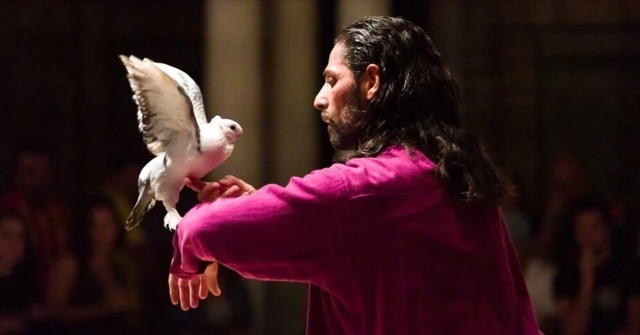
At the Aichi Triennale 2025, one experience stood out as a shared highlight for our group of thirteen: Bird by the brother-and-sister team Selma and Sofiane Ouissi.
Can humans and other creatures live together in today’s world? A dance with a dove is the beginning of a performance played out through unforeseeable events, silences, breaths, and shared gazes. — Aiichi Triennale
The dancer was Sofiane Ouissi, with live music—electronics and percussion—by Pan-J (Tokit Head Kumili). Both artists came from Tunisia. After the performance, it was revealed that the pure white dove featured on stage had been raised by Mr. Goto, who runs a farm in Aichi Prefecture dedicated to supporting independent living for people with disabilities. This was a fifty-minute performance created by these three presences.
Years ago, I once invited two artists, Dr. Chisa Hidaka, who dances with dolphins, and JoAnna Mendl Shaw, who dances with horses, to speak and show some of their video work at an event at my center, CRS. Chisa told us that she and her team only dance with wild dolphins in the open ocean and never seek to train or coerce them. The dancers and dolphins interact voluntarily, without “assumptions about who is ‘us’ and who is ‘animal.'” And JoAnna explained that she and her company never dance with “their own” horses; instead, they travel to where the horses live and carefully build relationships with them over time. Likewise, the Ouissi pair, in their dance with doves, also seeks, according to their event announcement, to transcend anthropocentric perspectives and “carve out new relations with existences that are accidental, uncertain acquaintance.”
Because of their size, horses pose a real danger if underestimated. Each horse has a distinct personality—some curious, some shy. Intelligent animals, they may even sense the flow of choreography and try to rush toward the end. The dancers must attune themselves to each horse’s temperament, sharpening their perception moment by moment so as not to lose trust. This requires not only equestrian training, but what Shaw described as a reconstruction of bodily context.
Doves, by contrast, are light. They do not run as horses do, but they possess wings that can carry them away at any moment. It is unclear whether a dove ever wishes to “finish quickly,” but it is certain that it makes no effort to “collaborate” or to “create a good work.” For this reason as well, Sofiane must have needed—like Shaw—a radically different reconstruction of bodily context than in dancing solo or with another human.
That was what I wanted to witness.
The event announcement says that “Bird was inspired by Selma and Sofiane Ouissi’s encounter with doves that lived in what had once been a movie theater. On the stage, a dancer and a dove share the same space and engage in an unpredictable dialogue by means of their bodies while respecting each other’s existence. Its poetic and subtle expression rethinks the essence of ‘living together’ in various parts of the world.”
In this performance, the dove could be described metaphorically as a godlike presence: complete in itself, natural, and uninterested in responding to human intention. It is the human who must first recognize and accept this condition, then carefully descend to the level at which such a presence exists.
At that level, which exceeds human understanding, there is no manual. If the dove can be thought of as love itself, the only possible action is courtship—or more precisely, quietly allowing oneself to be permeated by that love.
And “oneself” here does not refer only to the dancer’s body. Love extends in all directions. The entire space, including the audience, must also enter into contact with it.
When Sofiane began walking slowly around the venue, holding the dove and making eye contact with each audience member, I sensed that he was gathering love from the space itself. I envisioned invisible threads—not of spider silk, but of affection—being woven, drawing all of us into a shared field.
The dove moved from his hand to his shoulder, then to the crown of his head. When he opened his arms and bent his knees, the dove spread its wings and assumed a position for flight—a natural response, I later learned.
At this point, the dancer must not think. Thought does not belong to love.
He must not initiate action either; action, too, lies outside love.
Everything that is not love must be stripped away.
He senses the dove’s weight and lightness, its movement and faint sounds, responding and synchronizing with them. He slides his body into that delicate flow. The audience watches, breath held.
Sometimes his movements become dynamic, leaping through space; at other moments, they register only as subtle shifts of the hips or a slight twist of the ankle.
About twenty minutes in, a transformation occurs. The image of the dove as an individual creature seems to vanish from Sofiane’s sensory awareness, replaced by a pure sense of joy arising between the two. This was evident in the articulation of his arms, hips, and ankles.
Dance encompasses countless concepts, themes, techniques, and styles, but the body remains a body. Even if one wished for a third arm, expression must still be carried by two. Too often, this results in the repetition of habitual movement, or minor variations thereof.
Yet through this extended and careful courtship, Sofiane appeared to realize that the body he knew—his familiar sense of movement—had dissolved into the relationship itself and been replaced by something entirely new.
Relationship, then, is something that entails transformation at the level of the body. It is not a dance in which partners demand responses and align their steps. Rather, it is the act of listening closely to the presence of the other’s complete, almost sacred quality, and slipping into it after shedding the self one has constructed.
As Sofiane’s precise, sensitive movements—steadfast and unwavering at their core—merged with the dove, which remained free and unrestrained throughout, we in the audience were drawn deeply into that union.
It was bliss—nothing less than the essence of being alive.
Such presence is always there. And so this essence can be sought daily, simply by listening more closely. If one truly seeks it, it will, without doubt, be given.