I was excited to explore Kyotographie, the sprawling annual international photography festival in Kyoto. Now in its 12th year, it has become one of Asia’s largest photography festivals. It features 13 curated main exhibitions and more than 100 KG+, KG Select, and Special exhibitions installed in venues large and small all over Kyoto. One of the exhibitions I was most keen to visit was “You Don’t Die — The Story of Yet Another Iranian Uprising,” an exhibition at Sfera culled from 1000s of mostly anonymous images of the “Woman, Life, Freedom” uprising inside Iran, collected and authenticated by Le Monde photo editor Marie Sumalla and Le Monde journalist Ghazal Golshiri. With the assistance of Iranian colleagues Payam Elhami and Farzad Seifikaran, they established the date and location of each photo. Photographs by several professional Iranian photographers inside Iran also appeared in the exhibition.
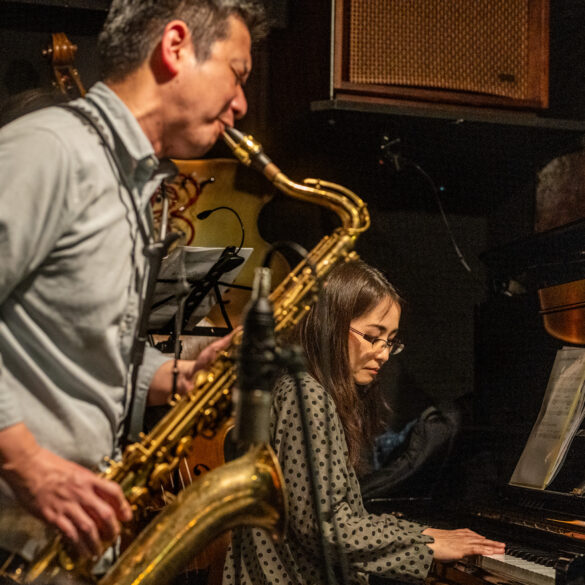
While struggling to find contemporary jazz venues in Osaka, I stumbled upon Studio T-Bone, a venue supporting both live jazz and photography and decided to visit. Pianist Yukari Sekiya 関谷 友加里 and percussionist Naoto Yamagishi 山㟁直人 やまぎしなおと were improvising together. While I didn't manage to get to know them well on that occasion, I was delighted to spend time with the creative family members running the studio. A chance encounter months later unexpectedly brought Yukari back into my mind. When I reached out to her, she responded, and I've now learned what a deep and inspiring artist and person she is, opening the door to possible future collaborations. It was a powerful reminder that we can't always see right away why our intuition speaks to us. Sometimes, it may be setting something in motion far in the future or for a purpose quite different from what we imagine.
My encounter with the well-known — but new to me — pianist Hitomi Nishiyama 西山瞳 at SUB Jazz Cafe, a seminal jazz club in Osaka, took me to places I never expected. Although she was playing jazz standards with a makeshift band, her music and career, characterized by curious changes in direction and exquisite elaborations on connections previously unrecognized, set us free.
The world is full of people who leave the place they were born, only to survive and then die in a place they never expected to live. The world is full of people who live without purpose, without any relationships, without any stories, or many that no one cares to know, despite the constant progress of everything around them. Such people tend to appear the most often in America, and even more in New York, the place where the no-identity-faces gather, the embodiment of the splendid America, the image that represents the most solid but also the most easily shattered dreams.
I saw one of them on the first morning after arriving in New York right after stepping out of a concrete hotel on Twenty-fourth Street, heading towards Seventh Avenue. For a moment, I had the idea of doing something different from the drivers — that is, following the African man to his destination.
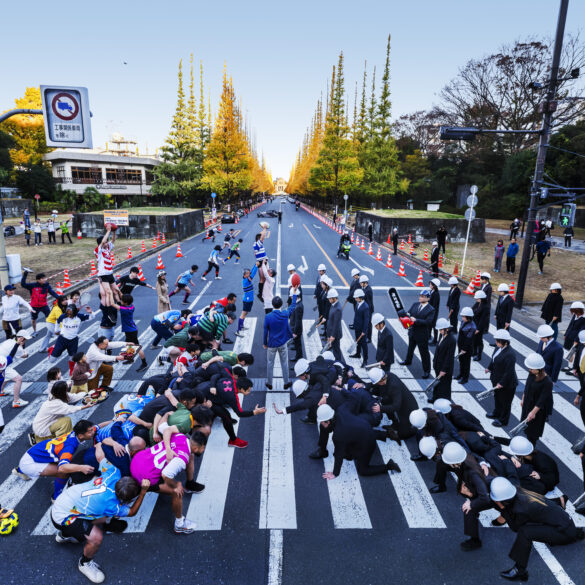
Masahiro Usami creates art, photographic mandalas, by undertaking a journey, as much relational as through time and space, to understand and capture the essence of a community’s journey in collaboration with that community. In his words, “Each individual photograph [in his long-running mandala series] features a central figure, all of whom come from different regions and standpoints, and then distributed in their environs are the people and things that express the world of that particular figure, just like the form of a Buddhist mandala painting.” His latest depicts the confrontation between citizens and developers over a proposed radical redevelopment of a beloved and historic park in the heart of Tokyo.
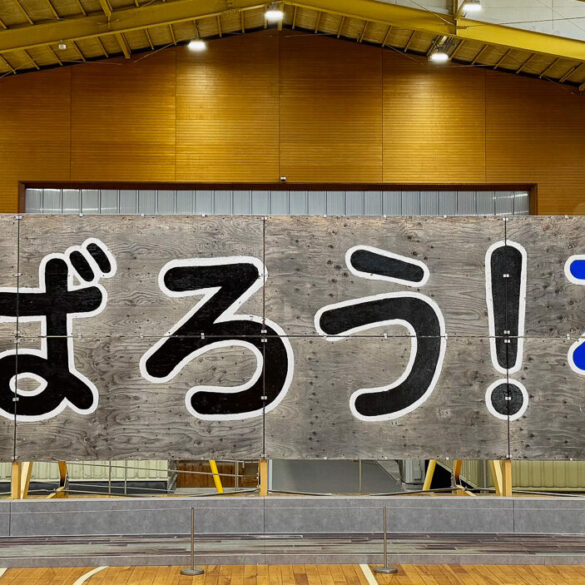
This large sign, emblazoned with the words がんばろう!石巻 meaning Let’s Go, Ishinomaki, was found placed in the ruins of downtown...
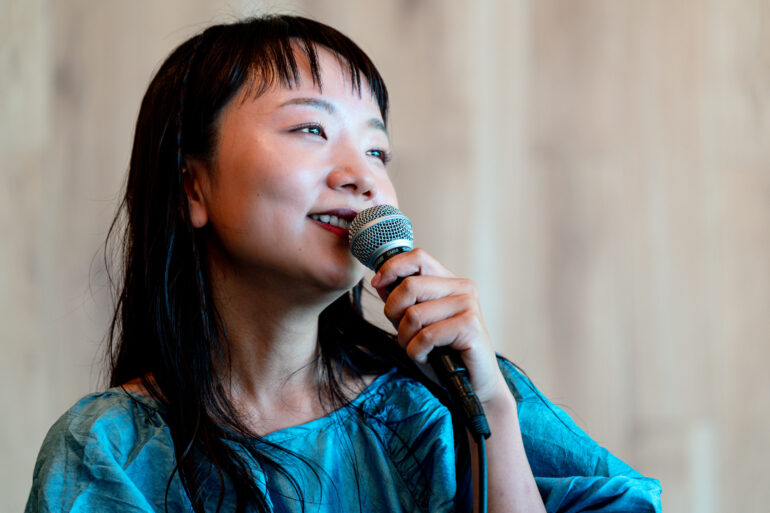
I had circled the KYOTOGRAPHIE KG+ Photographer Group WOMB’s 10th Anniversary exhibition as one not to miss. I was attracted to WOMB’s mission, which seemed to offer a feminine gaze yet take a metaphorical and expansive rather than body-centered view of a womb’s function. A small collective of Japanese female photographers who have been publishing WOMB photography magazine since September 2013, WOMB says they named their group and magazine to evoke “things that no one knows yet, a place where things are born (and grow).” Fortunately, I was able to meet two of the photographers, and among my many experiences at KYOTOGRAPHIE, this exhibition proved to be a highlight. Honestly, it was inspiring and rewarding beyond all expectations.
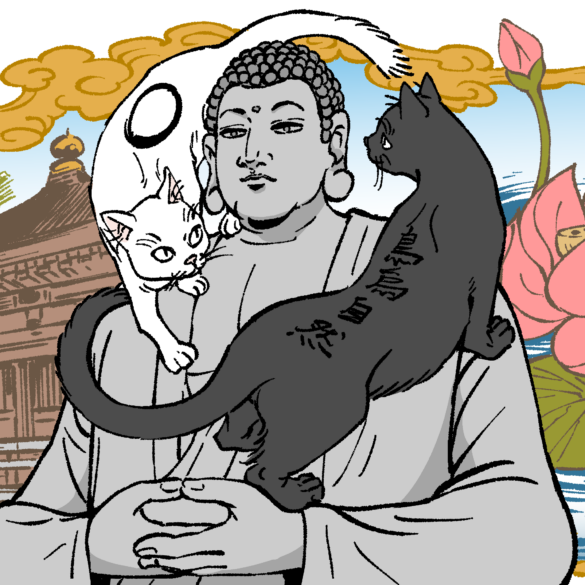
Photo © by Hiroki OtsukaOn my way from Kanazawa down to Hiroshima, I took a detour in Fukui Prefecture to visit Gotanjoji, a Sōtō Zen temple in Shoden-cho, Echizen City, known informally as a cat temple. I came for the cats, but I was also intrigued by the temple’s history, such as it is. While many temples in Japan are hundreds of years old, Gotanjoji was founded in 2002! Despite the temple's young age, its history dates back to the late 13th century Zen monk Keizan Jōkin 瑩山紹瑾, who was born in Echizen and was, I discovered, instrumental in opening Zen to women. Gotanjoji took it one step — or four? — further, bringing cats into the spiritual practice.
No More Content