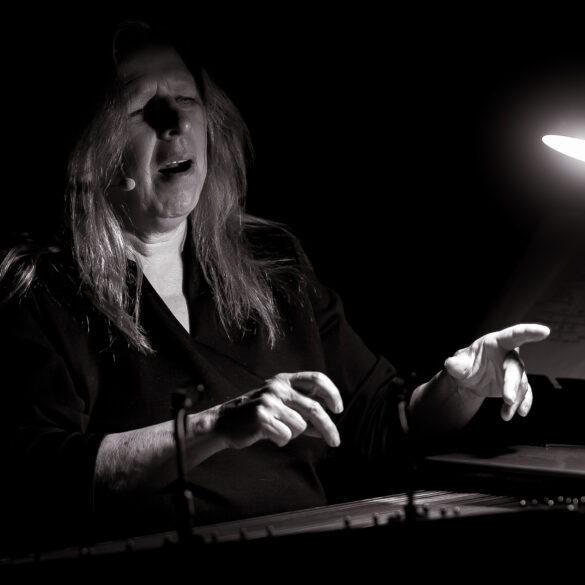
This was the only night I could conceivably visit Kanazawa, and fatefully, Sinikka was performing at the historic Mokkiriya jazz cafe and live house, founded in 1971, on this night, on tour from Norway. Meeting her in western Japan was as fortuitous as it is unlikely. Sinikka performs jazz-inflected songs inspired by the traditional music of the Forest Finns on a 39-string kantele (a kind of harp that sits horizontally on a table) that are haunting and unforgettable.
Sinikka’s singing is as clear as a bell. Yet, the purity of her voice and her decisive intonation, coupled with the dulcet sounds of her instrument, also express something profound, conveying compassion, mystery, and an ancient knowing. Gently, her music flows all around us, free of impurity and full of wonder, like a spring whose pristine and paliative waters well up from some primordial source. I wanted to know what makes Sinikka’s music so grounding, purifying, and ethereal — and what she was doing in Japan!
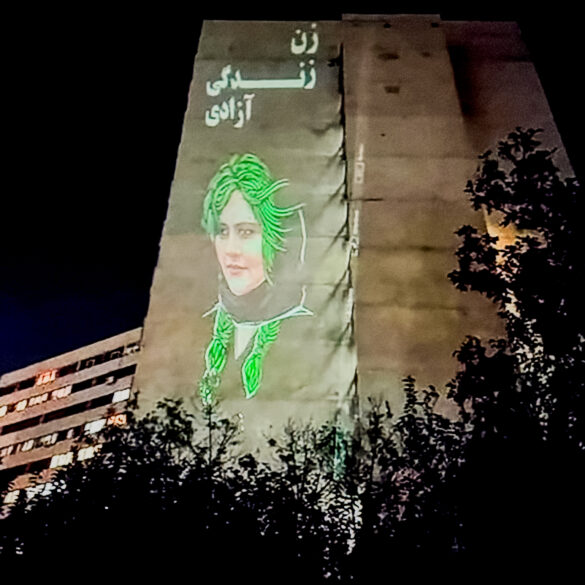
I was excited to explore Kyotographie, the sprawling annual international photography festival in Kyoto. Now in its 12th year, it has become one of Asia’s largest photography festivals. It features 13 curated main exhibitions and more than 100 KG+, KG Select, and Special exhibitions installed in venues large and small all over Kyoto. One of the exhibitions I was most keen to visit was “You Don’t Die — The Story of Yet Another Iranian Uprising,” an exhibition at Sfera culled from 1000s of mostly anonymous images of the “Woman, Life, Freedom” uprising inside Iran, collected and authenticated by Le Monde photo editor Marie Sumalla and Le Monde journalist Ghazal Golshiri. With the assistance of Iranian colleagues Payam Elhami and Farzad Seifikaran, they established the date and location of each photo. Photographs by several professional Iranian photographers inside Iran also appeared in the exhibition.
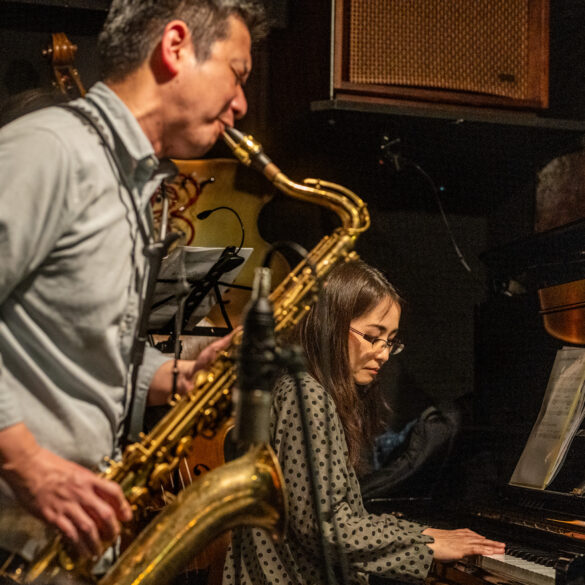
My encounter with the well-known — but new to me — pianist Hitomi Nishiyama 西山瞳 at SUB Jazz Cafe, a seminal jazz club in Osaka, took me to places I never expected. Although she was playing jazz standards with a makeshift band, her music and career, characterized by curious changes in direction and exquisite elaborations on connections previously unrecognized, set us free.
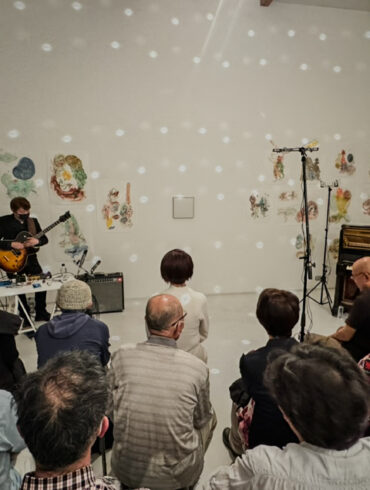
On my last night in Osaka, I attended the closing night reception for the solo exhibition 置き去られた鏡 The Forsaken Mirror by celebrated artist Chie Matsui 松井智惠. The performance consisted of music by avant-garde musicians sara (piano, perc.) & Shin’ichi Isohata 磯端伸 (guitar) and a poem read in Japanese, Korean, and English by Chie, Yangjah, and Miho, respectively. At first, I didn’t know what to make of the performance or the abstract, brightly colored prints surrounding a centrally hung mirror. Eventually, in the space created by the disorientation and abstraction, I reflected on who these people were, who I was, and the various identities we experience throughout life, which proved enlivening.
No More Content