
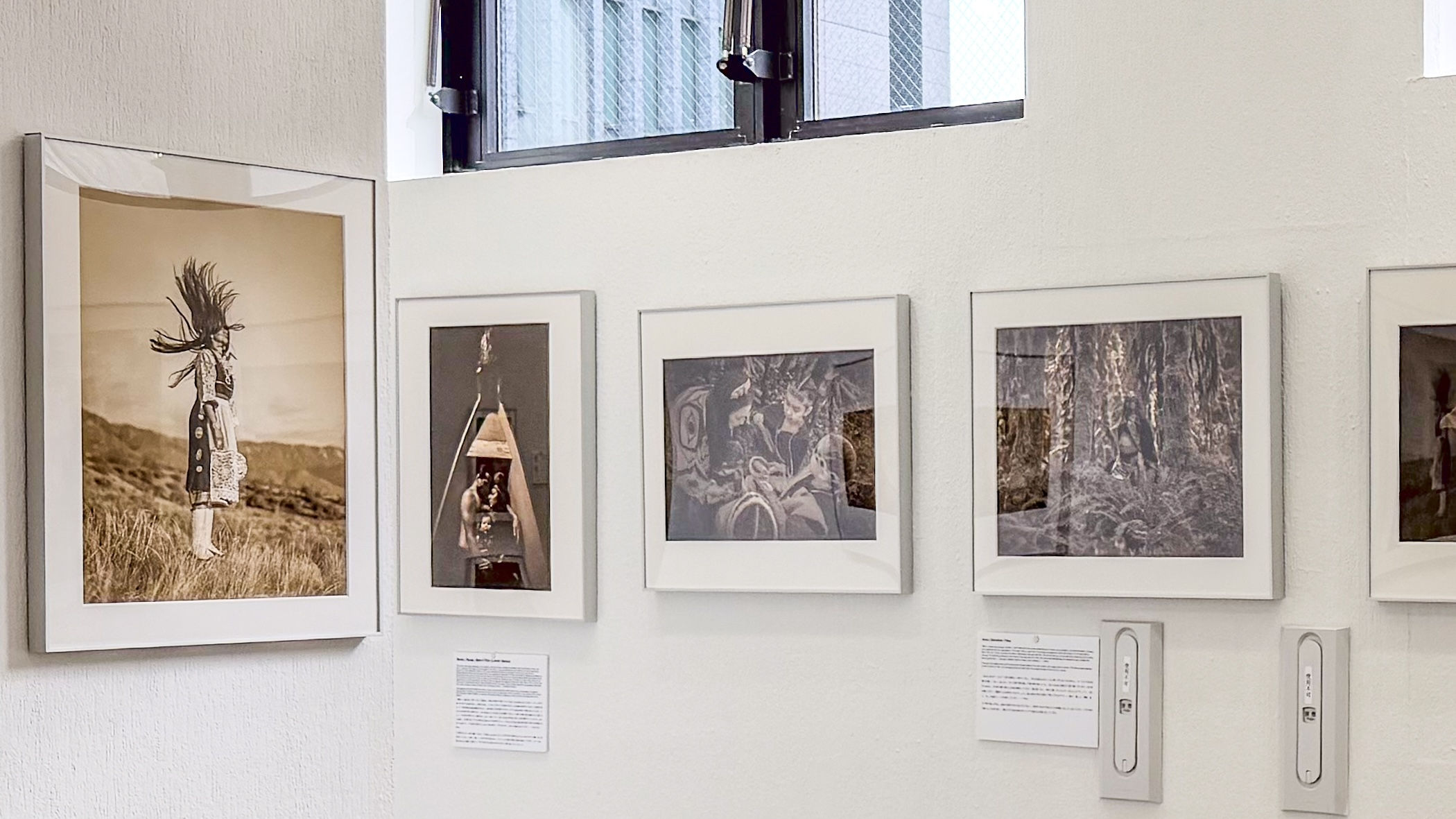

The moment I stood before Forever Free with Wind in My Hair by Zoë Marieh Urness (far left in the image above) at the Life Is Art Is Motherhood Is Art exhibition at Le Deco Gallery in Tokyo, I found myself almost frozen in place, wondering if this was what weightlessness might feel like.
I was there, standing in the gallery, and yet I felt as though I had entered a weightless space in the universe, beyond gravity.
The photograph I was looking at captured a moment when the wind seemed to be blowing. And yet what I felt was something quite different: a wind that had become completely still—a wind that seemed to hold me gently and ask me to remain exactly where I was.
You are still.
You are looking at freedom.
And as you look at freedom, you are released.
These words came to me as a kind of reading through the work.
I did not try to understand or interpret them. I simply remained there, quietly standing before the photograph.
As I allowed myself to feel this sense of stillness, the weightlessness in my awareness naturally began to extend beyond the photograph itself. My attention was drawn toward a window located diagonally behind me in the exhibition space.
I gazed through it for a while.
Something in me expanded.
Wait… I know this place.
And then, almost imperceptibly, my point of view shifted.
I suddenly had the strange sensation that I was looking up at the window of this exhibition space from below.
It was as though I were standing across the river, looking up at the building where the exhibition was taking place.
And then a precious memory I had completely forgotten suddenly returned, vividly and effortlessly.
Two years earlier, I had been standing in this very place with my child, Kanon, waiting to participate in an event called “A Telephone Call with the Cat God” — a playful experience involving a public telephone.
While we were waiting in line, I remember looking up at the building and wondering idly:
What kinds of things are happening inside this building?
I had been gazing at those very windows.
The stillness I experienced through the artwork had somehow opened a door in time and space.
And with that opening came the memory of Kanon’s joy:
“I got to talk to the Cat God! It was so much fun!”
And:
“The Cat God said, ‘Come and play again!’”
It was as though I had suddenly received an answer to something I had been sensing without knowing what it was.
There is no time.
Everything exists simultaneously within this eternal Now.
The light of Forever Free with Wind in My Hair did not merely communicate this idea to me. It allowed me to experience it.
Only after this profound experience did I begin to research the artwork and the artist.
At the exhibition, I had not realized that photography was permitted, so I had not even remembered the title of the work. All I had was the image held in my mind: the striking clothing, the natural surroundings, and the messages I had received while standing before it.
As I searched, I discovered that the work was by the artist Zoe Marie Arness, and that its title was Forever Free with Wind in My Hair.
The things I had received from the work—the wind, the feeling of weightlessness, the sense of being unbound and released—were already present in the very title the artist had given it.
I also learned that Urness carries within herself two Indigenous ancestral lineages: Cherokee on her father’s side and Tlingit on her mother’s.
I was moved by the image of these two worlds meeting within one person: the spirit of the northern sea and forests, and the voice of the southeastern land.
The Tlingit people, whose homelands are in the Pacific Northwest, have traditionally honored profound relationships with the natural world — the wind, animals, and sea — as well as with their ancestors, carrying their knowledge and stories through generations by oral tradition.
The Cherokee people originate in the southeastern United States, particularly around the Appalachian region of present-day Georgia and North Carolina, and were later subjected to forced removal, including the Trail of Tears, to lands farther west. Their relationship with the forests and rivers, and the development of their own written language, evoke for me a way of listening to the language of the land and living in relationship with it.
Then there is the regalia worn in the photograph.
I came to understand it not simply as clothing, but as prayer made wearable — a living tradition carried through generations.
To wear it is, in a sense, to participate in prayer.
It connects the wearer with those who came before and with those who are present now, transcending ordinary boundaries of time and space.
Perhaps this is why the clothing has somehow remained so vividly in my mind.
It seems to say:
Within you, too, the breath of your ancestors and the presence of Mother Earth are always surrounding you.
And perhaps this message is not meant only for the woman in the photograph.
Perhaps it is also reaching each one of us who encountered this work:
Remember.
You are looking at freedom.
And as you look at freedom, you are released.
Since encountering this work, I have continued to wonder:
What are we seeing in this everyday “work of art” called our life?
And:
What kind of breath, what kind of wind, is moving through this “work”?
The wind I felt that day has continued to blow within me.
It is a space of weightlessness.
When I gently step away from the feeling of being bound by the time of everyday life and surrender myself to the light radiating from this work, I find myself remembering — and touching again — a sense of existence beyond time.
And then I begin to notice something else:
prayers that are already being poured into our lives.
Through experiences that we might call miracles, one after another, they seem to arrive with a quiet invitation:
Don’t miss this.
Look.
Remember.
Perhaps this is what I mean by being invited into a powerful circulation of love — not by searching for miracles, but by becoming still enough to recognize what is already here.
For leading me into that experience, I offer my deepest gratitude to the exhibition Life Is Art Is Motherhood Is Art.
And to Forever Free with Wind in My Hair —
thank you for the wind that is still moving through me.