
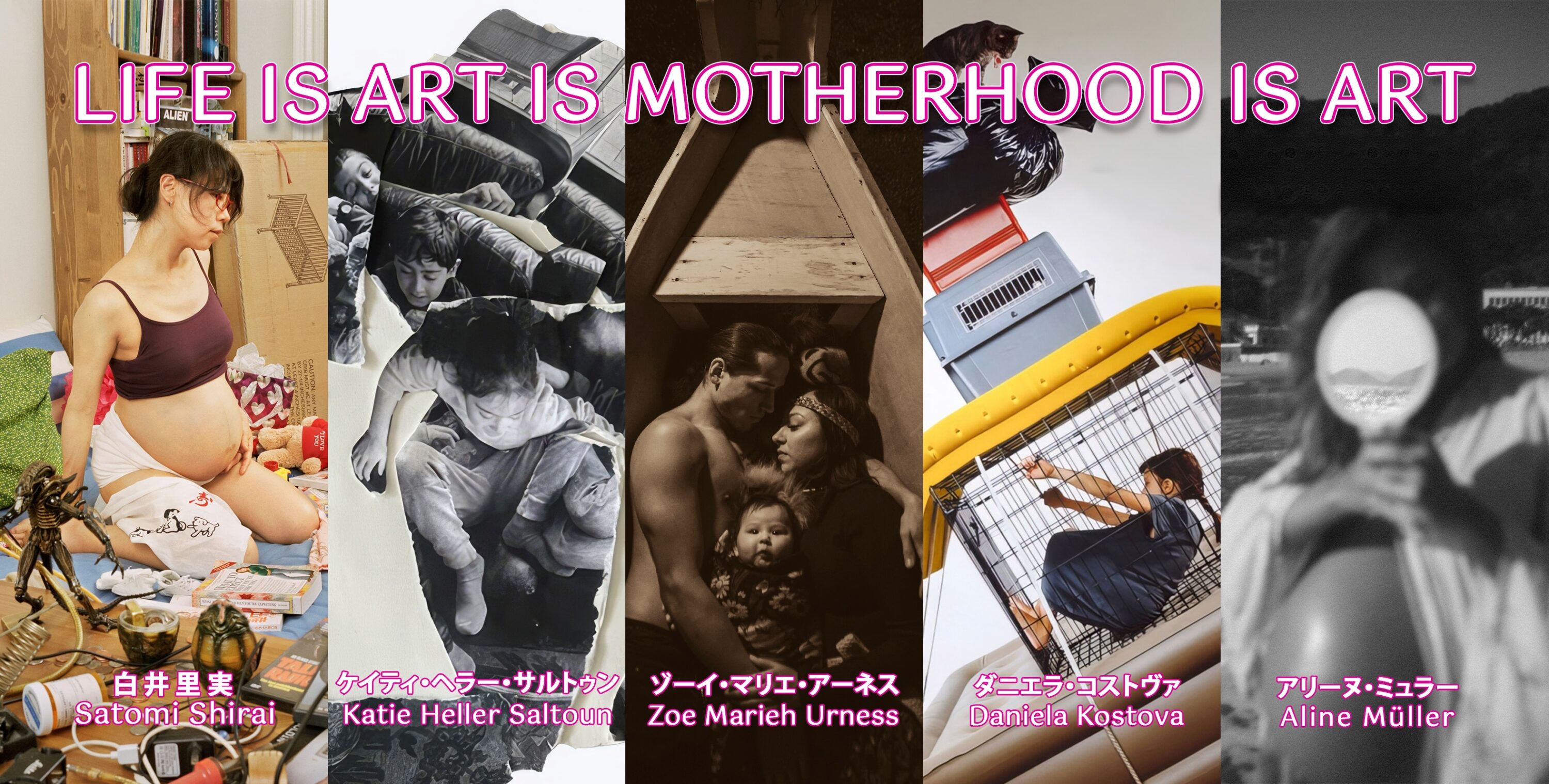

“LIFE IS ART IS MOTHERHOOD IS ART.”
The title alone immediately drew me in. To me, it seemed to suggest that life itself is art, motherhood is art, everyday life is art, and mothering — the expression of the maternal spirit — is an act of creation.
Without realizing it, “motherhood” has become one of the central themes of my own life.
For many years, I wished simply to make my own mother happy. Later, when I became a mother myself and found myself overwhelmed by the realities of raising children, I came to understand, with every fiber of my being, how essential it is for mothers themselves to be happy. That realization eventually led me to teach and learn through pelvic exercise programs designed to support women’s well-being. I even remember praying that mothers all over the world might find happiness.
Perhaps because of those experiences, I found myself viewing this exhibition through the eyes of a mother.
The joy of holding my newborn in my arms passed all too quickly. Before I knew it, I was consumed by the demands of parenting, and I never had the luxury of approaching motherhood with the kind of multifaceted, imaginative, and playful creativity expressed in these photographs. Looking back, I realized how little space I had to see child-rearing itself as an art.
Life Is Art Is Motherhood Is Art was a traveling exhibition, organized by the publisher of onlylove.art at Le Déco Gallery in Tokyo from May 19 to May 24, 2026, featuring photographs by five artists who are mothers: Daniela Kostova (Bulgaria), Aline Müller (Brazil), Katie Heller Saltoun (USA), Satomi Shirai 白井里実 (Japan), and Zoe Marieh Urness (Alaskan Tlingit and Cherokee).
The vivid imagination and delightful originality of Satomi Shirai‘s work continually invited gentle smiles. Each photograph was filled with thoughtful details that encouraged me to linger and explore every corner of the image.
 Photo © by Satomi Shirai
As I wandered through the exhibition, I found my heart naturally becoming still, as though I were sitting peacefully on the veranda of an old garden, basking in warm sunlight, or playing with shadows beneath an evening sky.
I also had the pleasure of speaking with the artist herself, whose innocent, genuine, and pure-hearted presence seemed to shine through every one of her works.
Parenthood is, after all, profoundly unpredictable. The boundaries between ourselves, our children, our work, and our responsibilities often become blurred. There are moments when we feel completely overwhelmed, unsure of what we are even doing, fumbling our way along a path that offers no single correct answer.
 Photo © by Katie Heller Saltoun
Yet there is also the incomparable joy of holding and caring for a vulnerable child. Looking at these photographs reminded me that motherhood has always been a journey into the unknown—filled with uncertainty, tenderness, and discovery.
How, then, can ordinary life become photography, art, and creation?
From the moment I entered the gallery, I felt a quiet sense of familiarity. Perhaps it was because every photograph radiated such gentle compassion toward motherhood in all its forms. Although each work possessed its own distinct personality, together they created a unified space where every unique voice belonged to a larger whole.
One photograph remained especially vivid in my memory: “Zoe and Violet (Tlingit Tribe)” by Zoë Marieh Urness.
 Photo © by Zoe Urness
I spent a long time standing before this piece.
There was something almost overwhelming about it — an unmistakable strength of intention that seemed to emanate from the image itself. Its scale felt almost cinematic, as though I were standing before a vast screen rather than a still photograph.
After reading the accompanying QR-code text, I felt that the artist’s understanding of the world, her deep commitment to her cultural traditions, and her unwavering gaze were inseparable from the life she lives. That connection gave the photograph an extraordinary vitality. Although it was a still image, it seemed almost alive, breathing with movement.
What radiated from the work went far beyond the social role of “mother.” It spoke of an entire way of living. To honor one’s ancestral traditions, to preserve and pass them on, and to live with freedom, courage, and resilience wherever one has been placed — that, I felt, is true creation.
As an Indigenous woman, as a mother, as an artist, and ultimately as a child of God, she offered a message that transcended every boundary.
Standing before her work, I felt newly encouraged. It reminded me that there is still so much I can do, faithfully and wholeheartedly, wherever life has placed me.
I left the exhibition deeply grateful for this extraordinary opportunity.
The accompanying works, including “Mariana (Yakama Nation)” and “Raven, Renae, Dem-I-Thia (Lummi Nation),” further deepened this experience. Each revealed motherhood not simply as a biological relationship, but as a sacred continuum connecting ancestry, culture, community, the natural world, and future generations.
Together, these photographs spoke of motherhood as both remembrance and creation — a living bridge through which love, identity, and wisdom continue to flow from one generation to the next.