
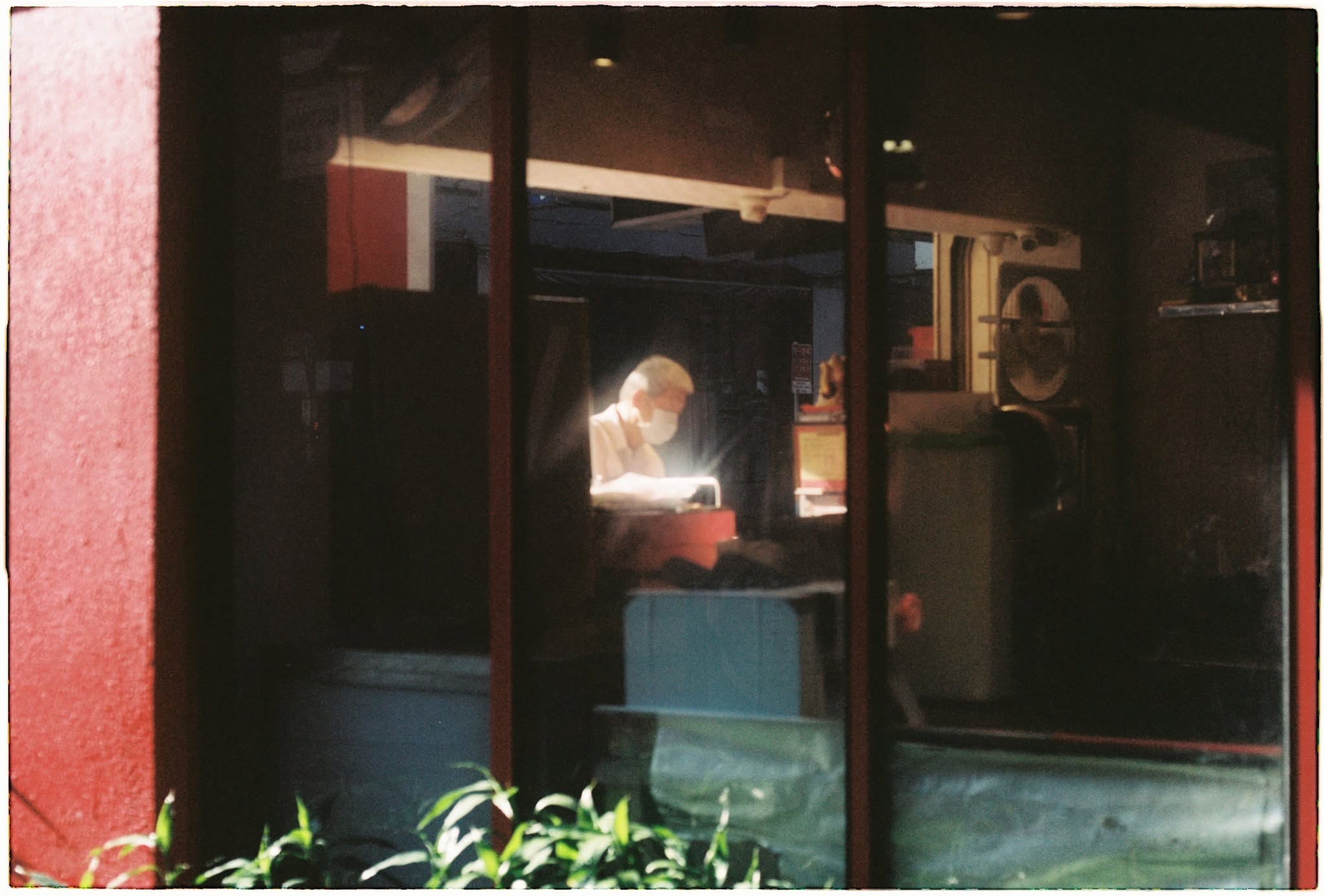

It was an unusual way to begin a morning in Taipei: waking to the sound of rain pounding against the glass wall of a five-star hotel in the heart of the city. Yet, if asked what most residents were doing these days, the answer would likely be the same — waking up, and watching the rain. Gaemi — a name once unfamiliar — had swept in from somewhere unknown, pulling with it streets, trees, buildings, and lives into a storm said to be the fiercest in a decade. The tremors felt on the plane just a day before had been its quiet announcement, now revealed in full form, with all its grandeur and menace: gray clouds saturating the sky for days, the rain shifting in moods from a soft drizzle to a roaring cascade, and winds rising from every direction. Its force was as unpredictable as it was destructive: flooding the roads, uprooting rows of trees, bringing the entire city to a halt — schools, offices, shopping centers, and public transport alike. Behind the towering panes of those opulent buildings, sandbags stood in formation, silent sentinels against the coming gusts. In kitchen cupboards, layers of provisions stacked high, ready for days of seclusion. Doors bolted, windows sealed, food secured — and still, television screens flickered with images of the storm’s latest aftermath: a sheet of metal torn from an unseen high-rise crashing down on a luxury car, crushing its rear half but sparing lives; up north, floods dragging tons of soil and sand across the country’s arterial roadways; within the city, trees swaying violently along deserted streets; and on the asphalt, rainwater gleaming like a new coat of paint laid over the faded, sun-dried surface.
This is Taipei — a city unlike any other, especially from June through October, when typhoons gather over the Pacific and sweep westward, crashing into the highlands, dragging tons of earth and stone into torrents that swallow trees, roads, cars, and people alike. Even Taipei’s most vibrant heart is not spared from the relentless hand of nature.
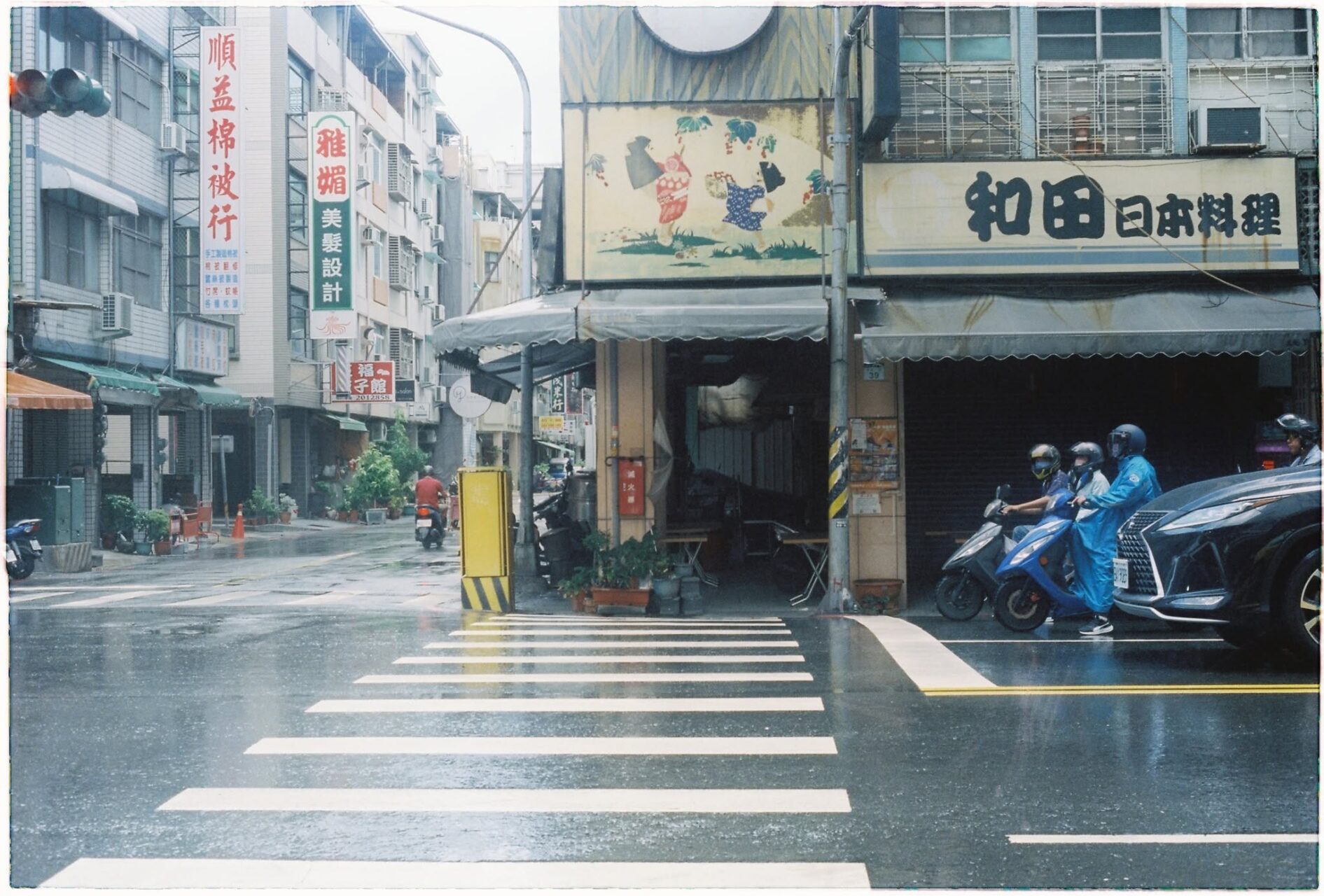 Photo © by Hai Yen Ho
It was the end of July — the very heart of typhoon season — and I had been here barely two days. From within this solid shelter, at barely five in the morning, I watched the rain hurl itself against the far side of the glass wall, only to shatter and dissolve into a ceaseless cascade of other broken drops. Along Songren Road, the hotel stood amid a typical urban complex of supermarkets, malls, schools, and office towers. Yet at that moment, it was impossible to tell which building served which purpose — the rain had washed the city into a pale, silvery haze, blurring every outline, turning towers old and new, tall and small, into wavering shadows in the mist. In this season of storms, only the shopping centers and restaurant arcades seemed to hold their pulse — part refuge, part distraction for a city stalled by the weather. There, young men and women sighed over raindrops on their carefully chosen clothes; children rejoiced at days off from school; housewives frowned, restless from being kept indoors too long. Pop music drifted through the air, yet it was drowned out by a thousand small noises — phone chimes, bursts of laughter, the hiss of food frying, and the hum of chatter echoing through the corridors. Still, wandering those air-conditioned towers, lost among the crowds and the bright chaos of consumption, was never the kind of solace I sought.
The solution, as in every journey before and after, was to follow instinct — to step beyond the polished city center once work was done, into another world, rougher, humbler, and far more alive. That was how I found myself before an old building on Nanjing West Road in the Datong district, its worn façade seamlessly joined with its neighbors into one long, timeworn block. The contrast between outside and in was startling: scale, sound, and intimacy all shifted the moment I crossed the threshold. I hadn’t realized it was a hostel until the doorman — a man whose name I never learned but whose kindness stayed with me — greeted me with quiet courtesy, his gray pupils widening slightly when I mentioned I was from Vietnam. Glancing at the confirmation email on my phone, he kindly pressed the elevator button and showed me the path lined with flattened cardboard to keep the rain and mud from scratching the tile floors. Unlike the bright, bustling ground floors rented to Starbucks, the upper levels held a dim, airless melancholy — no sunlight, no warmth, only the faint trace of human presence clinging to the walls.
True to its name, Starbox was divided into compact rooms and narrow sleeping pods — a haven for travelers of modest means and unhurried time. A place just wide enough for a small balcony looking out toward windows and vents of neighboring buildings, each enclosed by iron grilles, the whole scene washed in an awkward shade of gray. Within that cramped yet curious fellowship, I had the chance to meet the Taiwanese owner — a man who had set aside his passion for motorcycles to return home and run this little hostel between four sealed walls. He listened eagerly as I recounted my travels, then, with almost childlike sincerity, introduced me to a businessman friend “hoping to find a Vietnamese wife.” His wife, seemingly older and gentler, offered me a piece of cake in apology after brusquely declaring that they only accepted cash, not cards as I had assumed. Then there was an American student, diligently learning Mandarin with hopes of settling down here, who welcomed me with a cup of freshly brewed coffee upon my arrival. And a few other nameless souls — our exchanges reduced to brief nods when passing in the shared bathroom, or faint smiles traded on the balcony over rising wisps of smoke.
That balcony, with its three tiny plastic plants, a few tall iron chairs, a small lamp, and a cheap plywood table, became my quiet refuge. It was here that I devoured two thick books, worked and wrote through the mornings, and spoke with fellow travelers by night — for the two kinds of work I pursued demanded of me two opposing instincts: the precision of a mind before a screen, and the sensitivity of a heart before people. Most mornings, work kept me glued to the same spot until noon, surviving on a few biscuits or a glass of milk left from the day before. Only when the last task was done would I finally step out — book in hand, camera slung over my shoulder — to wander the streets and let myself drift, until I stumbled upon some small, remarkable corner of the city to call my own.
One such place was the small neighborhood bar across from the building where I stayed — a spot I nearly overlooked on my first day in Taipei. Its glass doors had remained firmly shut day and night, without a signboard or even a glimmer of light to suggest life within. Inside, the room was cluttered with mismatched relics from another time — not quite beautiful, and hardly coherent together: lampshades trimmed with lace and ornate Rococo-like flourishes; a square, mid-century leather armchair with its surface cracked and tired; a set of cloudy, imitation-crystal glasses, their engraved crests worn smooth by years of use. There were no coquettish waitresses, no chatty bartenders, no suave foreign managers who winked at every woman drinking alone — the kind of theatrics that fill other bars. Here, there was only one middle-aged woman, doing everything herself: taking orders, mixing drinks, serving tables, clearing them. Yet her greatest task — and perhaps her true gift — was to sit quietly and let her patrons do as they pleased. Even the endless rain and the dull gray sky that had blanketed the city for days seemed to leave her untouched, as if her world moved at a different tempo.
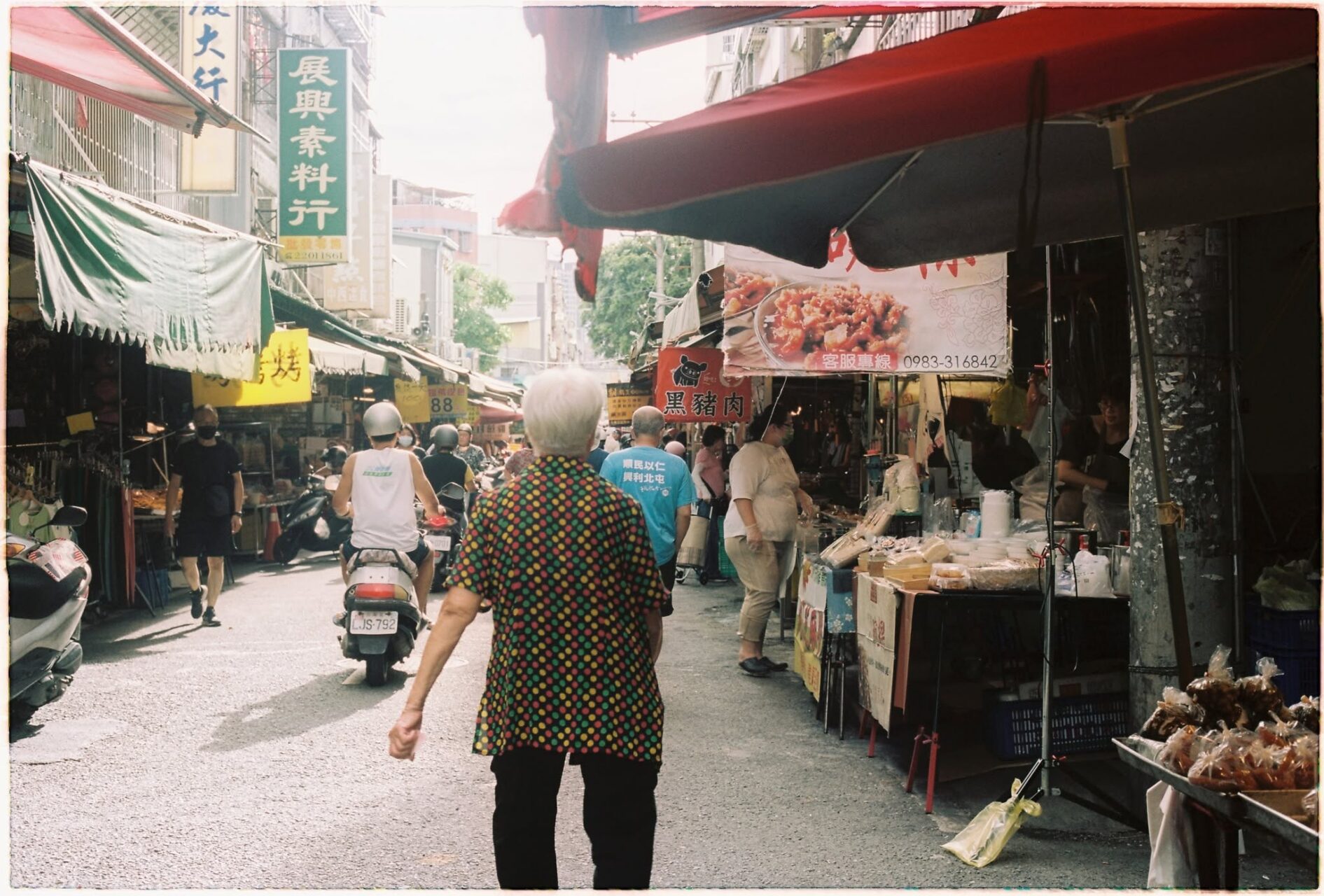 Photo © by Hai Yen Ho
I had never been anywhere so still. Just a pane of dulled glass separated it from the busy intersection outside, yet it felt like another dimension — one that folded space until only seven guests could fit. The only noise I heard was just the slow shuffle of the woman’s footsteps, the creak of the door as someone entered or left, and the faint squeak of skin against a leather armchair. There was no music, no chatter, not even the sound of a sigh. The only discomfort was the damp air — thick with rain and dust, turning heavy and musty as it lingered. Still, from the very first evening, I felt strangely at home there, reading three full chapters of Orhan Pamuk in one sitting.
It was also the only time I ever felt at ease being confined within the worn, aging hues that seemed to cling to every building in Taipei — a patina that had, over time, become a part of the city’s living memory. Unlike other metropolises brimming with gleaming structures born of the new millennium, Taipei is a city of the old — though never fragile. Built during the economic boom of the 1950s, most of its houses share a certain architectural kinship: boxy protrusions jutting out and folding back like pieces of a puzzle; walls clad in slim ceramic tiles — a quiet testament to the craft and endless patience of the builders; colors now dimmed and weary, their original brightness long faded; air-conditioning vents and tangled wires exposed along the façade; and above all, the feature that has haunted me most — the iron bars that encase nearly every window of every building. Those bars were once a pragmatic response to a city reshaped by waves of mainland immigrants and the rise of local gangs — a time when organized crime grew beyond self-defense and into a thriving, visible network of illicit trade. In those years, Taipei’s residents could only protect themselves by fortifying their homes, turning corridors and windows into private fortresses. Even now, long after those gangs have dissolved or moved elsewhere, the bars remain — framing space, enclosing time, shielding residents not only from the stares of foreign visitors but, in some ineffable way, from one another.
During the days I spent in Taipei, as the storm pushed the sun aside and left behind a curtain of soft, unending rain, I wandered through narrow, timeworn alleys, gazing at the latticed windows that pressed themselves against the city’s life. From behind those squared bars — beyond the layers of hanging clothes, plastic bags, cardboard boxes, mugs, food containers, and dog-eared books scattered on sills or tables — I could glimpse the lives of Taipei’s people: dim silhouettes, slow-moving impressions, remnants of a chaotic past that once gathered millions of souls caught between nostalgia for a lost homeland and faith in a new order. Behind those bars lived another story — one of longing to Westernize, to Americanize, to move forward, and yet, inevitably, to escape the bitter aftertaste of a China left behind. Yet temperament is never something one can easily cast aside — much like a person who, after losing a beloved, cannot bring themselves to look again at the keepsakes leftover, yet cannot bear to throw them away. In a place where economic policies shift every few years with the rise and fall of ruling parties, where political brilliance often belongs to a scholar known for prudence wrapped in openness, the old and the new — patriarchy and liberty, stability and upheaval — have woven themselves together in a strange, intricate tapestry during the city’s early decades of the new millennium. Even the legacy of its first female president, at the end of her final term, seems not quite enough to blur the distance between those opposites. Perhaps it is precisely this fervent Westernization — this restless urge to both preserve and outrun the past — that has turned the living rooms of typical Taipei families not into testaments of progress, but into quiet museums of a bygone culture. On mottled brick walls still faintly marked by a red “Double Happiness” character; behind cracked glass panes no one has bothered to replace; along decaying stairways wedged between two narrow homes, dark except for a sliver of light from the street; beside overgrown potted plants left untended for years — the city’s solitude breathes, its melancholy seeping through the ruins from the very moment I arrived.
Even now, when I think back on life behind those iron bars, I am still moved. They remind me of my grandfather, who would slowly appear behind the window grille to greet his children and grandchildren returning home for the holidays. I remember how the grille curved into two delicate initials — the entwined letters of his and my grandmother’s names — painted in green upon a sun-washed yellow wall, the kind one often found in French colonial architecture, opening toward the small courtyard outside. Like many intellectuals of his generation, shaped by both native traditions and a French education, my grandparents cultivated a life of disciplined elegance: buttered bread each morning, sports in the afternoon, and the making of sticky rice cakes and candied fruits every Lunar New Year. It was a graceful way of living, drawn from the harmony between Eastern roots and Western refinement — a way of life my grandparents upheld even after the war, when their property was seized, and my grandmother had to pass food through the bars to my grandfather imprisoned in a reeducation camp for years on end. Those intertwined initials on the iron grille — that quiet symbol of endurance and grace — remain, even now, as a steadfast emblem of everything they refused to surrender.
My grandparents’ house, one could say, once knew its days of splendor. Yet by the time they were both gone, it had been patched and reinforced with materials ill-suited to its form, by unskilled hands and an unrefined eye — until all that remained was a fragmented structure, stripped of the grace that once defined it. The brilliance that had once shimmered there had dulled into decay; the iron grilles rusted with time, their quaint, green-painted curves standing awkwardly amid the glittering modern façades around them. That dissonance — between the fading bars and the new radiance encroaching upon them — left me with a vivid impression of decline, not merely of a building, but of an entire era of beauty that had passed, never to return.
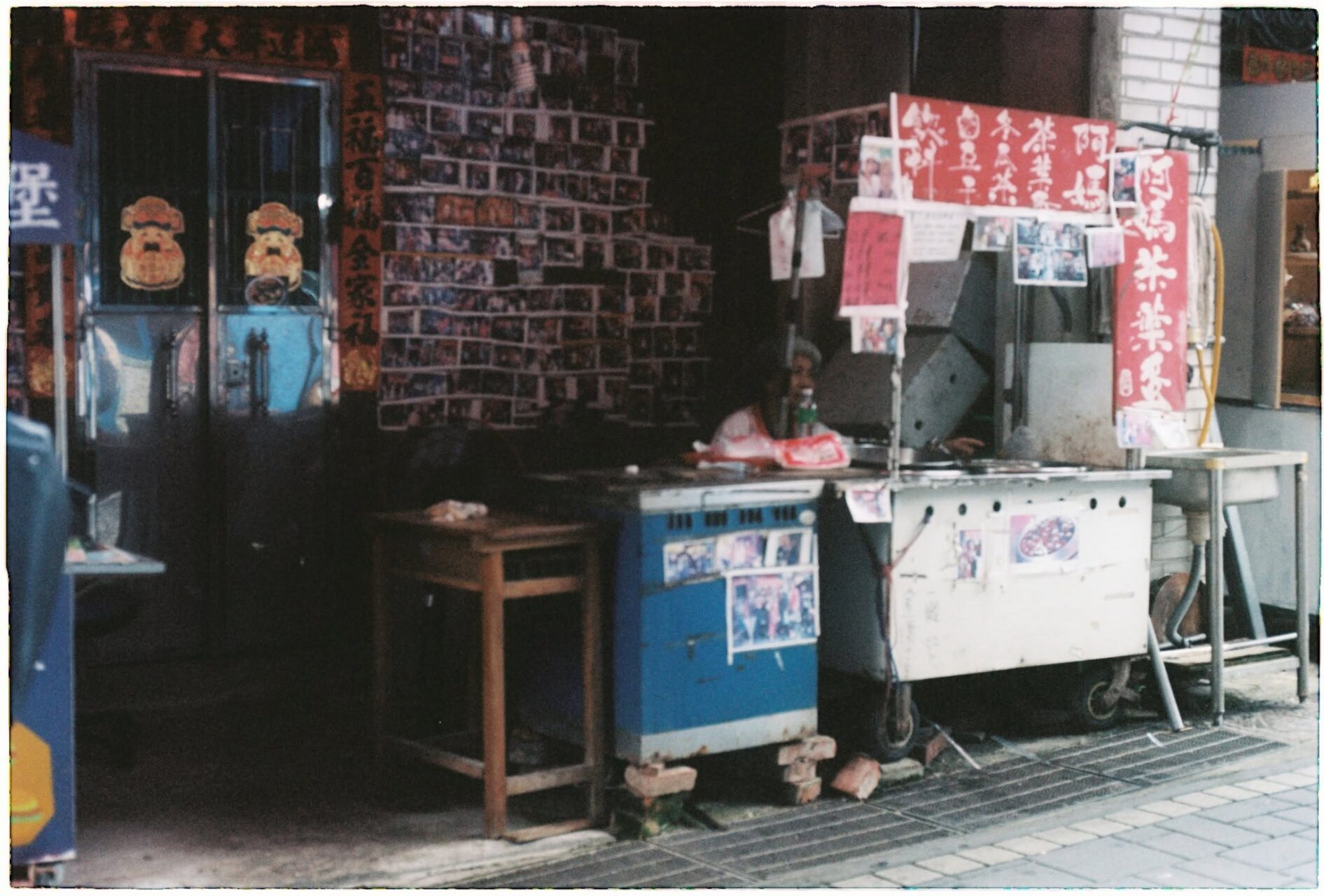 Photo © by Hai Yen Ho
Of course, it is not that Taipei lacks grand architecture, nor that its economy has fallen into stagnation — I mean nothing of the sort. But try, just once, to leave the broad avenues and their gleaming towers, to turn instead into one of the narrow lanes twisting between neighborhoods; look closely at what lies within, and perhaps the same feeling will stir in anyone. During my wandering days of temporary shelter, I scarcely encountered a single newly built home. The prevailing state seemed to be one of age — old, very old, and impossibly old — where the memories of bygone years stood exposed in every wall and window. Some houses were so deteriorated that their facades had turned completely black, as if they had only just survived a terrible fire. Others, not as ancient, had grown rigid and ashen, their original colors long indiscernible. The newest structures, perhaps, were the few apartment blocks unframed by iron bars around their balconies and windows — like the one containing the hostel where I had stayed. And yet even their incongruous presence did little to brighten the cityscape, for from their windows, all one could see were the cold, unyielding grilles pressed against the windows of the older homes across the street.
And then came the final days of that rain-soaked sky.
That morning, the sunlight was soft, the air was clear. I offered a silent farewell to those around me, boarded a train, and began to leave. Behind me, the rust-colored window grilles glimmered faintly under the sun — almost resembling the graceful, curved bars on my grandparents’ old window. I kept my eyes fixed on them until they vanished behind the rising sprawl of new developments along the route to Taoyuan Airport — past the forests that opened and closed like breathing, past the tunnels cutting straight through the mountain. Since then, whenever life begins to feel stifling, my thoughts drift back to that existence behind the iron bars of Taipei: the doorman with the gray eyes; the hostel owner who spoke endlessly about motorcycles; the hostess, awkwardly offering me a slice of cake from her refrigerator; the young American smoking on the balcony; and the quiet, middle-aged woman in the bar — always appearing still, pressed into themselves, staring at me with a vacant expression, as if our brief encounters had never happened at all.
Perhaps they would not agree with me, but it was precisely those haunted faces, that subdued life I imagined for them in those few fleeting days, that became the soul of the place for me. It was what bound me deeply to Taipei — on one hand, rekindling the memory of my grandparents’ faded dreams; on the other, unfolding a reverie of a city quietly in decline. In some way, that sorrow, soaked deep into my bones during my time there, cast over Taipei an eternal kind of grace — a beauty that could only be erased when the city cloaks itself entirely in newness: new structures, new colors, new ways of keeping itself safe. Something brushed aside the remnants of the old bars.
A day like that, surely, is not one to be wished for.